

The picket lines are down. The deals are signed. But the question that hung over the 2023 strikes,who is writing the script, the human or the machine?,has not gone away. It has only moved from the sidewalk to the writer’s room and the development office. The fear is real: that tools built to assist will be used to replace, that studios will treat the writer as optional and the algorithm as the author. The counter-fear is also real: that in refusing to use new tools, writers hand the future to those who do. Neither extreme holds. The answer lies in how we define the tool. Is it a script generator, or is it the creator’s cockpit?
That distinction is not semantic. A script generator implies that the machine produces the draft; the writer edits or approves. A creator’s cockpit implies that the writer flies the story,structure, character, tone, every beat,and the tool provides instruments: a map, feedback, consistency checks, a way to see the whole film before a single frame is shot. One model threatens the craft and the credit that writers fought for. The other extends it. This article addresses the ethics of automation in Hollywood by drawing that line clearly, and by arguing that the right tools do not replace the writer; they make the writer harder to replace.
What the Strikes Were Really About
The WGA strike was not a Luddite revolt. Writers did not march because they wanted to ban technology. They marched because they had seen how technology, in the wrong hands and with the wrong incentives, could be used to shrink their role and their pay. The concern was never “computers are bad.” It was “studios will use computers to do our job on the cheap and call it efficiency.” That is an ethical and economic problem, not a technical one. The solution is not to outlaw tools. It is to insist that tools serve the writer and that the writer remains the author.
When a studio says it wants to “streamline development,” the writer hears “fewer writers, more output.” When a tool is sold as “generate a first draft in minutes,” the writer hears “your job is now to edit an algorithm.” The ethical position is straightforward: the writer must remain the originator of the story. Dialogue, structure, character arcs, theme,these belong to the human in the room. The tool can suggest, organize, flag inconsistencies, and visualize. It should not draft the scene, pitch the twist, or decide the ending. That boundary is what turns a threat into an asset.
The writer must remain the originator of the story. The tool can suggest, organize, and visualize. It should not draft the scene, pitch the twist, or decide the ending.
Assistant vs. Replacement
Think of it as two product categories. In one category, you type a logline or a genre, and the system returns pages of script. You might tweak lines, swap scenes, or regenerate. You are in the role of editor or curator. The machine is in the role of first drafter. That model is what writers and the Guild rightfully resist. It blurs authorship. It trains studios to expect “good enough” from a box and to treat the writer as a polish pass. It also produces the kind of homogenized, surface-level prose that readers and audiences can smell a mile away. Nobody wins except the spreadsheet.
In the other category, the writer writes. The writer makes every creative decision: what happens, who says what, how the scene lands. The tool sits beside them. It might offer a timeline so they can see act lengths and beat placement at a glance. It might flag when a character’s action in scene 12 contradicts their stated goal in scene 3. It might suggest that the midpoint feels rushed or that a subplot has gone cold. It does not write the fix. It surfaces the problem. The writer chooses whether to fix it and how. That is an assistant. That is a cockpit. The human is still flying.
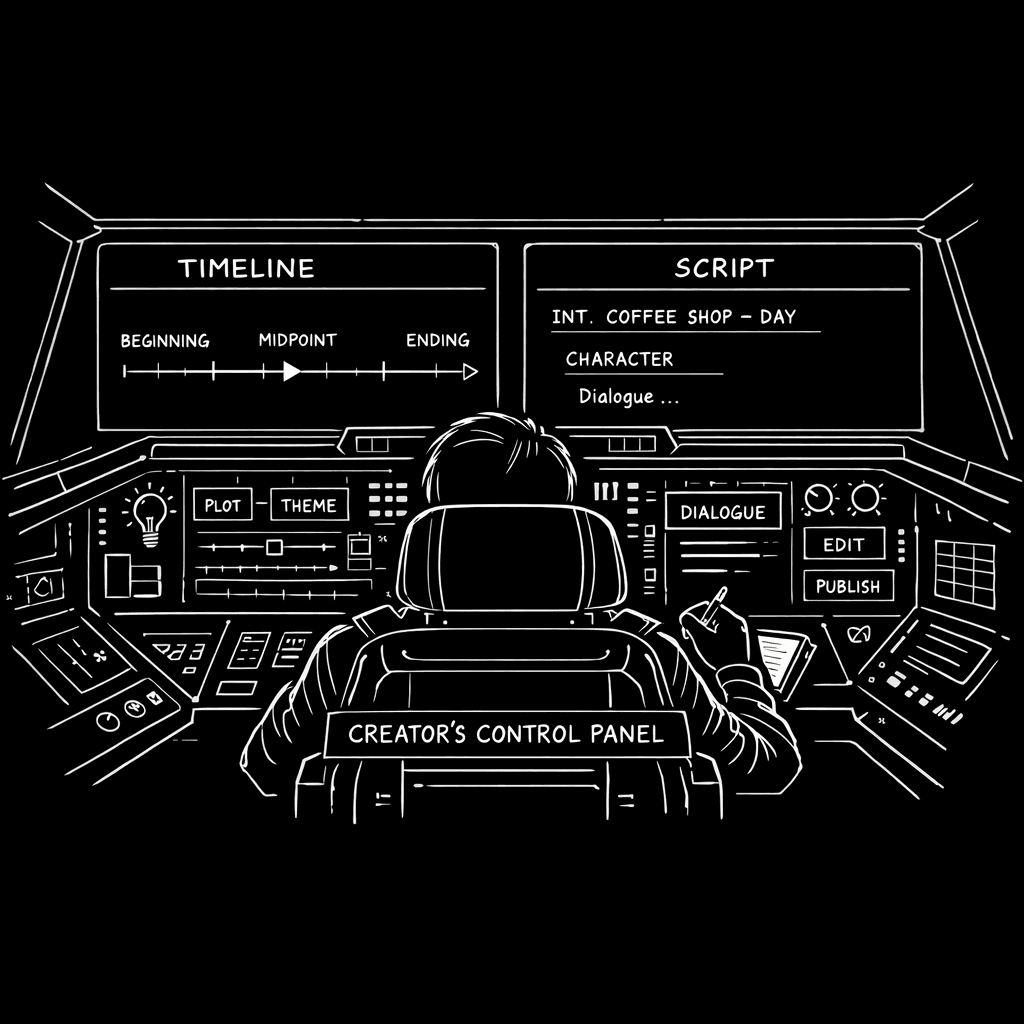
BODY IMAGE 1 PROMPT: Dark mode technical sketch. Solid black background. A single seat (pilot) in the center. Around it: a horizontal timeline, a script page, a small “spectator” and “document” icon. Thin white hand-drawn lines. The pilot is the only “human” element; everything else is instrument. Minimalist, high-contrast.
ScreenWeaver is built on the second model. It is not a script generator. It is a screenwriting environment where the Living Story Map, character tracking, and two specialized assistants,the Virtual Spectator and the Documentalist,support the writer without taking the wheel. You write the scene. The Spectator might tell you the rhythm sags. The Documentalist might tell you that you just introduced a character who isn’t in the project Bible. You decide what to do. The tool does not output dialogue or plot. It outputs clarity. That is the ethical line: tools that augment the creator’s ability to see and control the story, without substituting for the creator’s voice.
| Model | Who Writes | Ethical Risk |
|---|---|---|
| Script generator | Machine drafts; human edits | Authorship blur; studios devalue the writer; homogenized output |
| Creator’s cockpit | Human writes; tool organizes, flags, visualizes | Low,writer remains author; tool extends capability without replacing judgment |
Why Credits and Contract Matter
The Guild’s agreements now include language on the use of “material produced by” certain technologies. That is a floor, not a ceiling. The real protection is cultural and practical. Writers need to know what they are using. If your tool generates pages, that is material that may be subject to disclosure and credit rules. If your tool only helps you see structure, check consistency, or export to PDF, you are not “using AI to write”,you are using software to work. The cockpit model keeps you squarely in the second camp. You are not submitting machine output. You are submitting your script, produced in an environment that gave you better instruments.
Producers and executives have a role too. When they evaluate a tool or a workflow, the question should be: does this preserve or diminish the writer’s creative control? If the pitch is “we can do more scripts with fewer writers,” that is the replacement model. If the pitch is “writers can deliver tighter, more consistent drafts because they can see the whole story at once,” that is the cockpit model. Supporting the second is not only ethically sound; it is better for the product. Audiences notice when a script feels generic. They notice when a show has a distinct voice. Voice comes from writers, not from generators.
The Fear of Homogenization
One of the quietest but sharpest fears among writers is that even “assistive” tools will nudge everyone toward the same beats, the same structures, the same rhythm. If the tool is trained on existing scripts, does it not reinforce the median? There is a real risk when the tool is optimized for “what usually works.” The answer is to design tools that expose structure and inconsistency without prescribing content. ScreenWeaver’s Virtual Spectator, for example, reacts to rhythm and clarity; it does not suggest what should happen next. The Architect,another layer in the same environment,can suggest structural fixes (e.g., “this sequence is long; consider splitting”) without writing the new scene. You keep your voice. The tool keeps out of the content.
For more on how to keep your voice while using structural feedback, our guide on using tools to break writer’s block without losing your voice applies the same principle: the machine helps you see the problem; you solve it in your words.
BODY IMAGE 2 PROMPT: Dark mode technical sketch. Solid black background. A single script page in the foreground with a thin “Written by” line at the bottom. Behind it, a faint timeline and a small “spectator” icon,supporting, not overlapping, the page. Thin white lines, hand-drawn feel, high-contrast.
What Responsible Tools Look Like
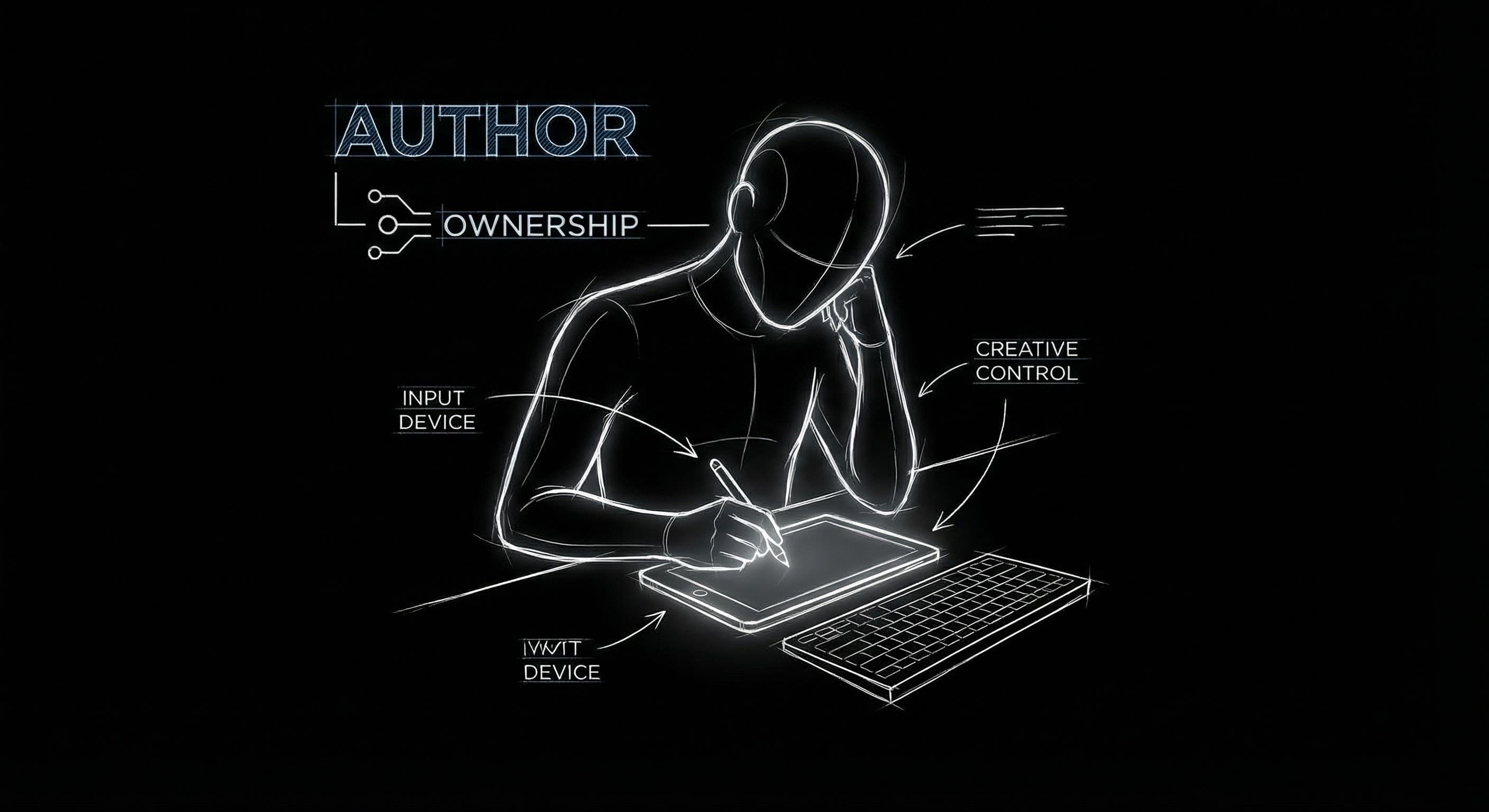
Responsible tools make the writer’s job easier without making the writer optional. They do not generate scenes or dialogue. They do not “complete” your thought. They do help you see the full story, track characters, catch contradictions, and export in the formats the industry expects. They also respect the writer’s ownership of the text. Your script is yours. The tool does not train on your work to improve a shared model without your consent. It does not send your drafts to a third party for “enhancement.” Privacy and ownership are part of the ethics of the cockpit: you are the pilot, and the instruments do not fly away with your data.
ScreenWeaver fits that description. The Living Story Map is yours. The script is yours. The assistants react to what you wrote; they do not inject what they wrote. When you export to PDF or Final Draft, you are exporting your document. That is the standard other tools should be held to. As discussed in our piece on what augmented screenwriting actually means, the goal is clarity and control, not automation of authorship.
The Creator’s Cockpit in Practice
What does “cockpit” mean on a daily basis? You sit down to write. You have a timeline in front of you: acts, sequences, beats. You know how long each section is. You can see if the second act is twice the length of the first, or if a subplot has only one beat in the last forty pages. You do not have to flip through a separate outline or keep a mental map. The map is on screen. When you write a scene, it appears on the timeline. When you move a block, the script reflows. The tool is not suggesting what to write. It is showing you where you are and what you have. That visibility reduces the cognitive load of holding the whole story in your head. It also makes it easier to spot structural problems before they become rewrites.
The same applies to the assistants. The Virtual Spectator might note that a sequence feels rushed or that tension drops before the midpoint. The Documentalist might flag that you have given a character a detail,a hometown, a profession,that contradicts the project Bible. In both cases, you receive information. You decide the fix. Maybe you add a beat. Maybe you change the detail. The tool does not write the addition or the correction. It surfaces the issue. That is augmentation: your judgment, plus better data. For a deeper look at how structure and script stay in sync, our guide on the death of the static outline explains why a single, bi-directional object beats two documents that drift apart.
The Strategic Takeaway
The ethics of automation in Hollywood are not about whether to use new tools. They are about which tools to use and how. The script generator is a replacement model. It undermines the writer’s role and the quality of the work. The creator’s cockpit is an assistant model. It keeps the writer in the center, with better visibility and fewer drudgery tasks. The industry will keep evolving. Writers who adopt the cockpit,who insist on tools that extend their ability to see and control the story,are not betraying the craft. They are defending it. The best way to ensure that the machine never gets the credit is to ensure that the machine never gets the draft.
Final Step
Build your next script with Screenweaver
Move from ideas to production-ready pages faster with timeline-native writing and AI-assisted story flow.
Try Screenweaver