
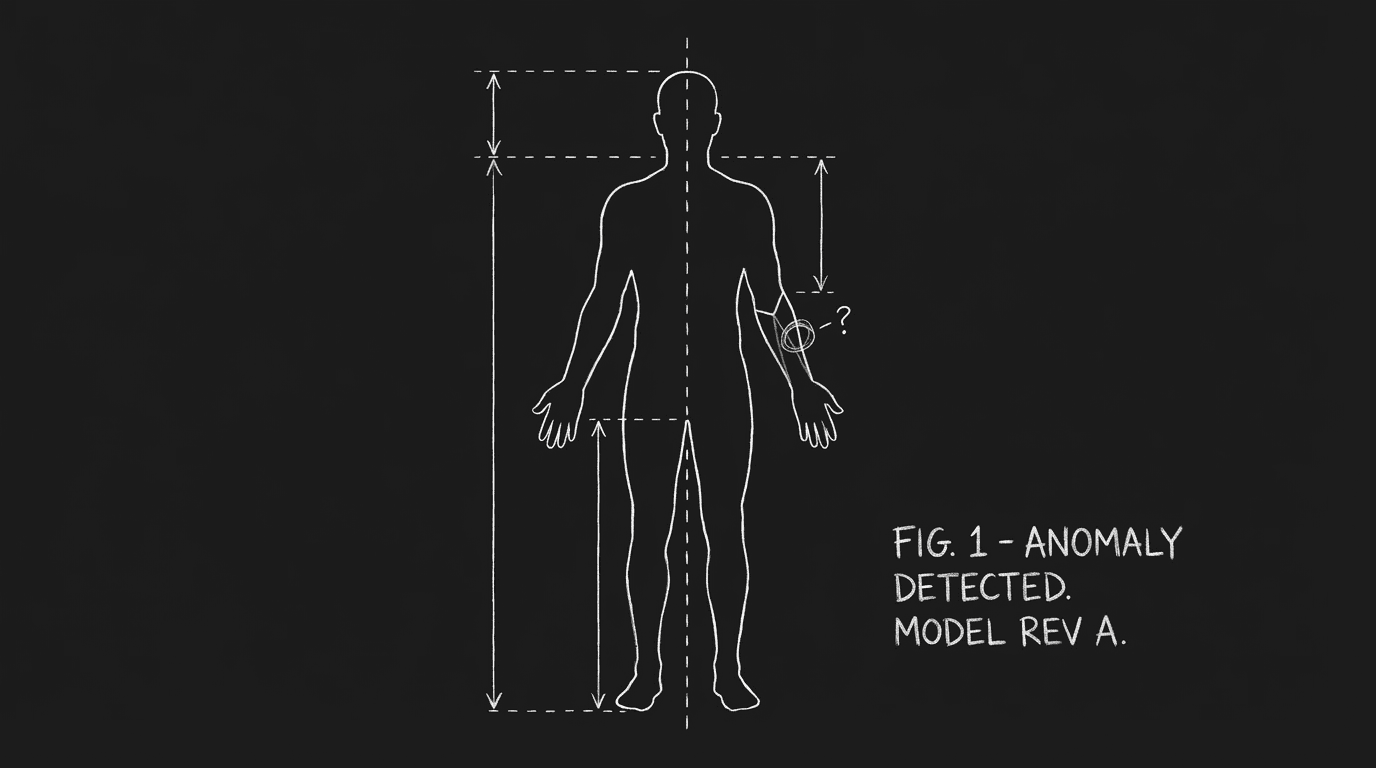
Hero image prompt: Dark mode technical sketch. Solid black background, thin white hand-drawn lines. A single human silhouette with one detail wrong, an extra joint, a line that doesn’t belong, a shape that suggests something under the skin. No gore, no color. Minimalist, unsettling.
The line between terrifying and gratuitous is thin. Body horror lives on that line. When it works, we feel it in our own skin, the wrongness of something that shouldn’t change, changing. When it doesn’t, we look away for the wrong reason. Not because we’re scared. Because we’re bored or grossed out by effect for effect’s sake. The craft isn’t in how much you show. It’s in what you choose to describe and how. Here’s how to make the body a source of dread without crossing into the gratuitous.
The most effective body horror isn’t the most graphic. It’s the most specific. One wrong detail, clearly imagined, hits harder than a paragraph of gore.
Think about The Fly. We don’t see every stage of the transformation in full detail. We see enough. We see the fingernail. We see the way he eats. We see the moment when he’s no longer fully human. The horror is in the recognition, we know what a body is supposed to do. When it does something else, we don’t need a lot of description. We need the right detail. The same principle applies on the page. You’re not writing a medical textbook. You’re writing the one moment that makes the reader feel it.
Why Body Horror Works (When It’s Earned)
Body horror taps into something primal. We rely on our bodies. They’re supposed to be stable. When they betray us, when they change, break, or become unfamiliar, we feel a kind of violation that’s different from external threat. The monster can be outside. In body horror, the monster is or becomes the self. That’s why the genre can be so intense. It’s also why it can tip into excess. If the audience feels like you’re piling on for shock, they disconnect. If they feel like the violation is part of the story, the cost of something, the result of something, the metaphor for something, they stay with you.
The best body horror is tied to theme. Hereditary uses the body to talk about inheritance, what we pass down, what we can’t control. The Fly uses it to talk about obsession and the loss of the self. Videodrome uses it to talk about how media gets under the skin. When the visceral imagery is in conversation with the story’s ideas, it doesn’t feel like decoration. It feels like the only way to say what you’re saying. So before you write the most intense moments, ask: what is this transformation or violation doing in the story? If the answer is “being scary,” dig deeper. If the answer is “showing the cost of X” or “making visible the theme of Y,” you have a reason for the imagery. That reason is what keeps it from feeling gratuitous.
The Rule of One Wrong Detail
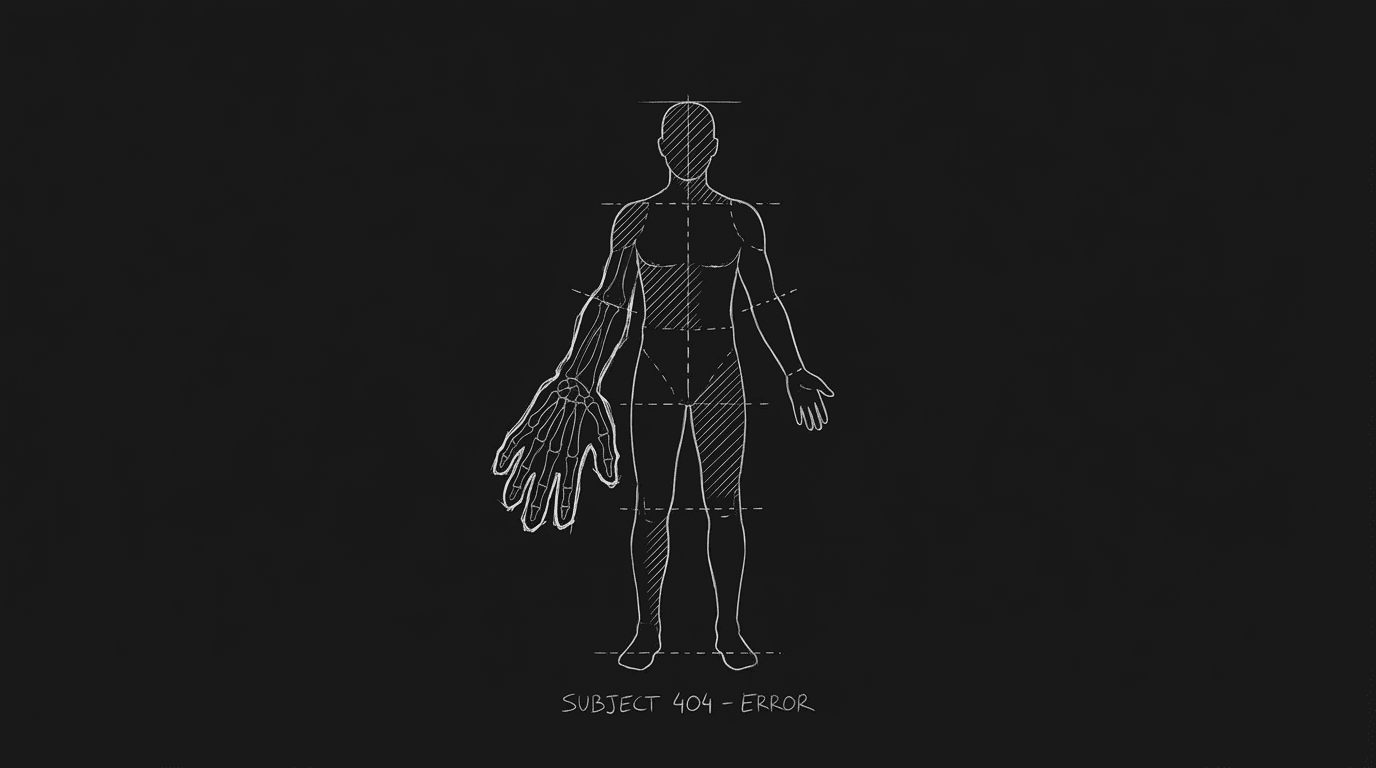
You don’t have to describe everything. Often the most effective approach is to pick one thing that’s wrong and describe it clearly. The rest can be implied. A character touches their face and their finger goes through. A character looks at their hand and the fingers are too many. A character tries to speak and the sound that comes out isn’t a voice. The reader’s brain fills in the rest. That’s more powerful than a full anatomical description because the audience is doing the work. They’re imagining it. And what they imagine is often worse than what you could write.
On the page, that means resisting the urge to overwrite. One strong action line. One clear image. Then cut away, or move to reaction, or let the next beat land. The horror lives in the gap between what you show and what the reader infers. For more on controlling what the audience sees and doesn’t see, our guide on writing monsters and describing less to scare more applies directly: the same principle of restraint works for the body.
Tone and POV: Who’s Experiencing It?
Body horror hits differently depending on whose experience we’re in. If we’re with the person whose body is changing, we get the internal horror, the wrongness from the inside. If we’re with someone watching, we get the external horror, the wrongness of seeing someone we care about become something else. Both are valid. The choice affects how you write. From the inside, you might focus on sensation. The way it feels. The way the body doesn’t respond the way it should. From the outside, you might focus on what’s visible. The way they move. The way they don’t look like themselves anymore. Don’t mix the two in the same moment. Choose a perspective and commit. The reader needs to know whose horror they’re in.
Relatable Scenario: The Script That Goes Too Far
You’ve written a transformation scene. When you read it back, it’s a paragraph of anatomy. Bones, skin, fluids. It’s accurate. It’s also numbing. The reader has checked out by the second sentence. So you cut. You keep one moment. The moment when they look in the mirror and their reflection doesn’t blink when they blink. Or the moment when they try to pick something up and their hand doesn’t close right. One clear beat. The rest is implied. Now the scene has room to breathe. The horror has room to land.
Relatable Scenario: The Script That Shies Away
You’re writing body horror but you’re afraid of going too far. So you write around it. “Something terrible happens.” “He changes.” The audience never feels it. They’re told that it’s horrible but they don’t see or feel the wrongness. So you add one concrete detail. Not the full picture. One thing that’s wrong. The way the skin moves when it shouldn’t. The sound. The smell. One specific, sensory detail makes the horror real. You don’t have to describe the whole transformation. You have to describe enough that the reader’s body responds.
Try it free
Try Screenweaver for free on your script
It is free. Import your existing project, get a clearer view of your outline, and regain control of your story structure in minutes.
Start FreeThe Trench Warfare Section: What Beginners Get Wrong
Equating graphic with effective. More blood, more description, more anatomy doesn’t mean more fear. It often means less. The audience gets numb. Fix: choose the one detail that carries the wrongness. Describe it clearly. Let the rest live in the reader’s imagination.
Separating the horror from the story. If the body horror feels like a set piece that could be cut without affecting the plot or theme, it will feel gratuitous. Fix: tie the violation to character or theme. What does this transformation cost? What does it represent? When the imagery is doing narrative work, it earns its place.
Writing from no perspective. We’re not clearly in the character’s experience or in the observer’s. The description floats. Fix: anchor every visceral moment in a POV. We feel what they feel, or we see what they see. One perspective per beat.
Using vague language. “Something indescribable.” “A horror beyond words.” If you don’t describe it, the audience can’t feel it. Fix: find the one thing you can describe. The one sound. The one movement. Specificity does the work. Vagueness doesn’t.
| Approach | Effect | When to Use |
|---|---|---|
| One wrong detail, clearly described | Reader fills in the rest; often more powerful | Most body horror moments |
| Full description | Can numb; use sparingly | When the full picture is the point (e.g. reveal) |
| Implication only | Can feel like a cop-out | When the horror is off-screen and we see reaction |
| Internal POV (sensation) | We feel it with the character | When the character is the one changing |
| External POV (observation) | We see it with the witness | When someone else is changing and we’re with the witness |
[YOUTUBE VIDEO: Breakdown of one or two iconic body horror moments, e.g. The Fly or Hereditary, showing how much is shown vs implied and how one detail carries the scene.]
Step-by-Step: Writing a Visceral Beat
Choose the moment. What is the one thing that’s wrong? Not a list. One thing. Then choose the perspective. Are we inside the body or outside? Then write one to three lines. Concrete. Sensory. No “indescribable.” No pile of adjectives. Read it back. Can a reader see or feel it? If yes, stop. If no, add one more specific detail. Cut anything that’s redundant. The goal is the minimum amount of description that produces the maximum response. For more on how to keep tension high without over-writing, see writing the jump scare, the same economy applies.
One External Resource
For context on the genre’s history and themes, see the Body horror entry on Wikipedia. Reference only; not affiliated.
The Perspective
Body horror is about the violation of the one thing we think we can trust, ourselves. The most effective way to write it isn’t to show everything. It’s to show the one thing that makes the reader feel the wrongness in their own body. Be specific. Be brief. Let them do the rest. That’s the line between terrifying and gratuitous. One detail, earned.
Final Step
Build your next script with Screenweaver
Move from ideas to production-ready pages faster with timeline-native writing and AI-assisted story flow.
Try Screenweaver