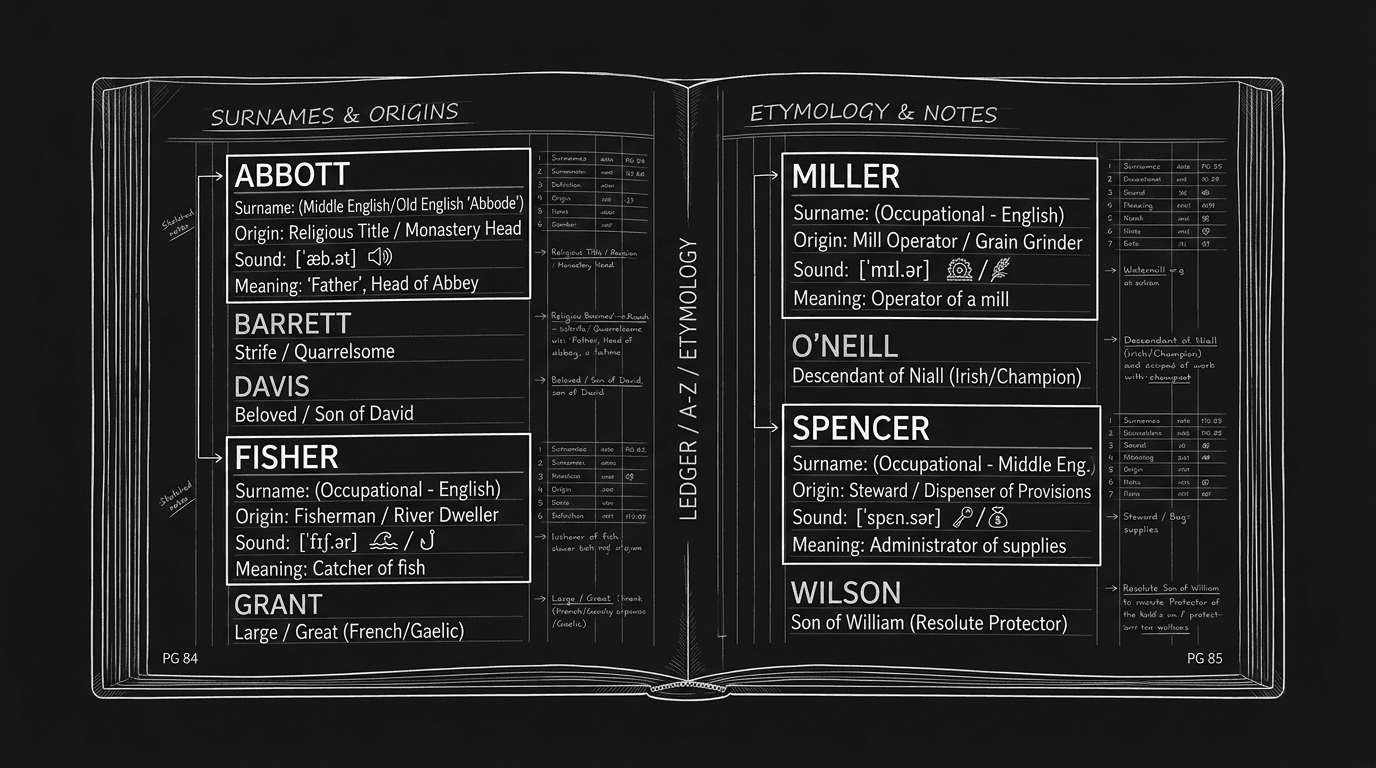

The name has to fit. The detective sounds like a "Murdoch" or a "Vance", you can't say why, but the wrong surname would break the character. Sometimes you need more than fit: you need meaning. A villain whose name echoes "shadow" or "stone." A family whose surnames signal class, region, or migration. You've cycled through a hundred options. Your brain is stuck on the same five. An LLM can't name your character for you, you'll know when it's right, but it can generate lists filtered by etymology, sound, and connotation. You get a long list. You pick the one that clicks.
The machine doesn't choose the name. It expands the menu. Your job is to know what you're filtering for: meaning, sound, era, or culture, then sift until one name feels like the character.
Here's the tension. Random name generators give you "realistic" lists that are often generic. You need constraints. "Surnames of Scottish origin that sound sharp and short." "English surnames from the 1800s that suggest rural labor." "Names that have a 'k' or hard 'c' and feel slightly ominous." When you add those constraints to a prompt, the LLM can return dozens of options that match. Some will be wrong (wrong era, wrong connotation). You discard those. The value is in the shortlist. You're not outsourcing the choice. You're outsourcing the search.
Cinematic workflow frames
These two visuals work as a pair: the first shows Cinematic workflow still, first angle, 35mm film grain, and the second shifts to Cinematic workflow still, second angle, 35mm film grain—compare them briefly, then move on.
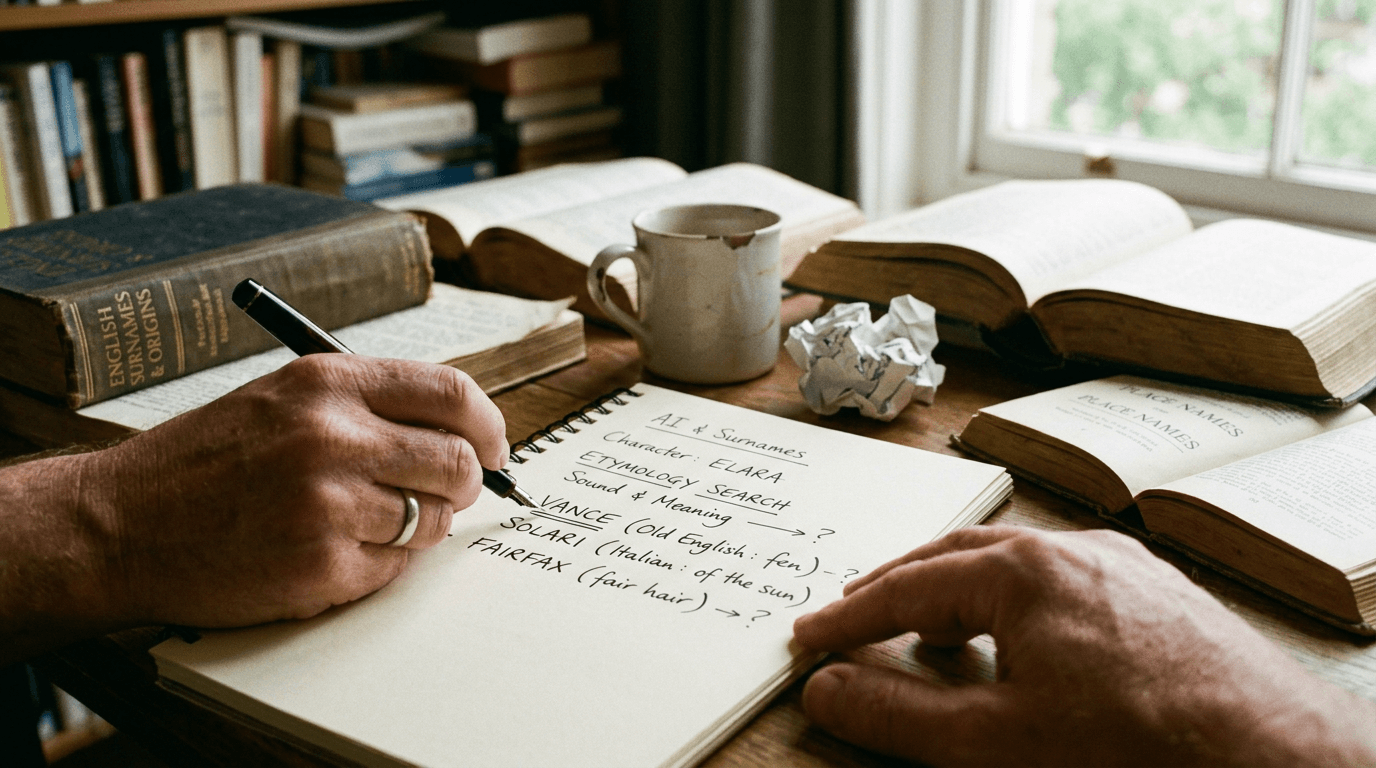
Why Etymology and Sound Matter
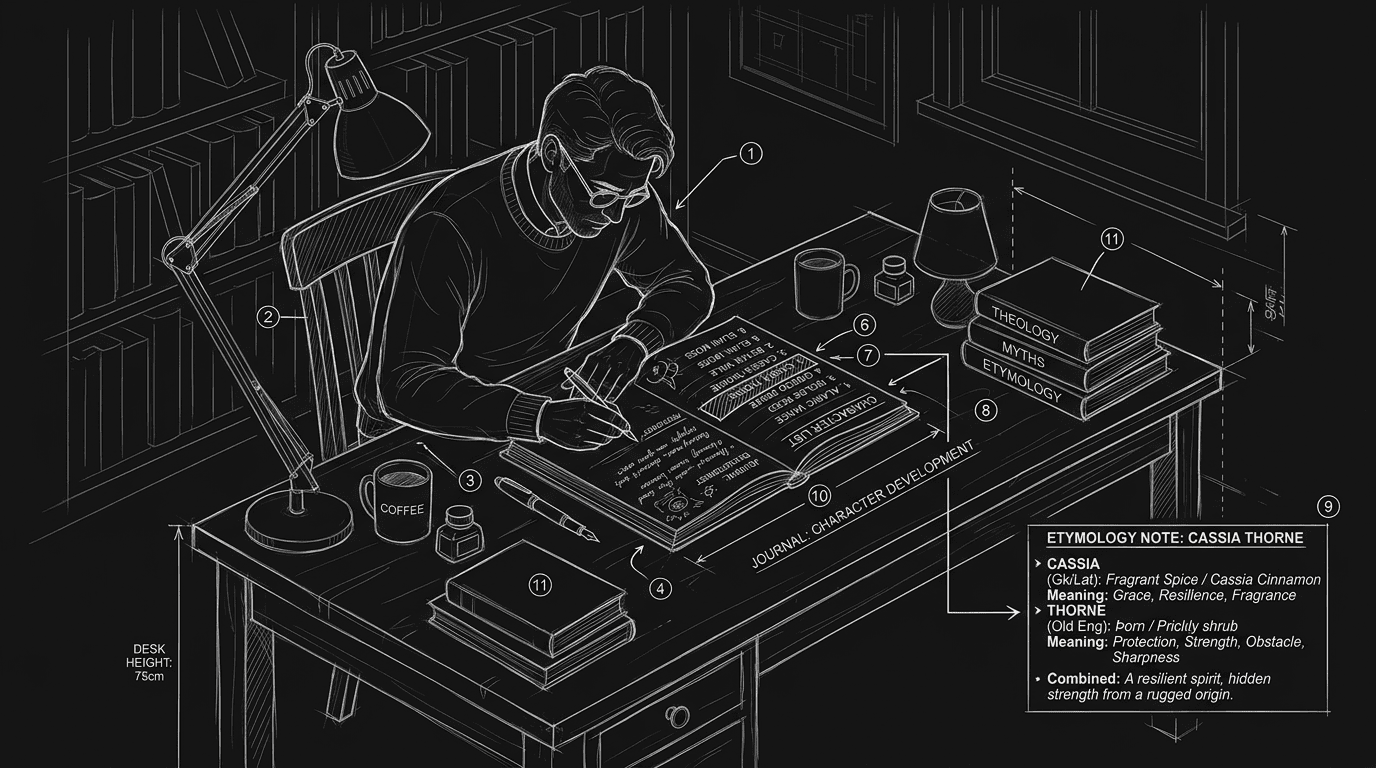
Etymology ties the name to a place, a trade, or a trait. Smith, Cooper, Fletcher, occupations. Hill, Brook, Shaw, landscape. That can support character: a character whose name means "son of the blacksmith" might carry a sense of craft or labor. You don't have to explain it on the page. The reader may not look it up. But the writer who chose "Fletcher" for an archer is layering meaning. Sound affects how the name lands when said aloud. Short, punchy names (Blake, Cross) feel different from long, soft ones (Montgomery, Ashworth). For film and TV, names are spoken. The right sound can make a character stick; the wrong one can feel off in the room. So the workflow is: define what you want (meaning, sound, era, culture). Ask the LLM for options that fit. Verify etymology if it matters. Pick the name that feels right. You own the choice; the machine owns the breadth of the list.
The Workflow: From Brief to Shortlist
Step 1: Write a one-line brief. "Male lead, 40s, detective. Surname should sound no-nonsense, possibly one or two syllables. Prefer English or Scottish. No comic or aristocratic feel." Or: "Antagonist. Surname should have a dark or cold connotation, etymology or sound. Not obviously evil; subtle." The brief is your filter. Without it, you get random lists.
Step 2: Prompt for a list with constraints. "List 30 English or Scottish surnames that are one or two syllables, sound authoritative and no-nonsense, and have no aristocratic or comic connotation. Include brief etymology or meaning where relevant." Or: "List 20 surnames that have a meaning related to shadow, stone, winter, or darkness. Mix origins. Include the etymology for each." You're asking for options, not one answer. Temperature 0.7–0.9 can help with variety.
Step 3: Verify the ones you like. LLMs can be wrong about etymology. If you care that "Blackwood" really has that meaning, check a name dictionary or etymology site. Use the list as a starting point; use a human source to confirm. For sound, you don't need to verify, say the name aloud. If it fits the character, it fits.
Step 4: Narrow to three to five. Don't commit to the first name. Pick three to five that match the brief. Say them in a line of dialogue. "Detective Murdoch, we need you downstairs." Which one feels right? You choose. The machine gave you the pool.
Step 5: Check for unintended overlap. Make sure the surname doesn't clash with another character's name (same first letter, similar sound) or with a famous person in the same genre. A quick search or a second pass over the cast list saves you a note later.
| You provide | LLM returns | You do |
|---|---|---|
| Brief: sound, meaning, origin, era | 20–50 surnames, with optional etymology | Verify meaning if needed; pick 3–5; say aloud; choose one |
| "Dark connotation" | List of names with shadow/stone/cold etc. | Check etymology; pick the one that fits the character |
| "Short, sharp, detective" | List of 1–2 syllable surnames | Say in dialogue; choose |
For distinct character voices once the names are set, distinct voices and blind read helps. For naming and character design in ensemble casts, character foils and support cast is related.
Relatable Scenario: The Detective Who Needed a Surname
You have the first name. The surname has to sound like someone who's been on the job too long, tired, no flourish. You prompt: "30 English or Scottish surnames, 1–2 syllables, that sound worn and no-nonsense. Not aristocratic. Include brief meaning or origin." You get a list. "Vance" jumps out. You check: it's from "fen" or "marsh", land. You use it. The machine didn't name the character. It gave you a list that included Vance. You picked it.
Try it free
Try Screenweaver for free on your script
It is free. Import your existing project, get a clearer view of your outline, and regain control of your story structure in minutes.
Start FreeRelatable Scenario: The Villain Whose Name Should Hint at Darkness
You don't want an obvious "Dark Lord" name. You want something that feels slightly off, cold or shadowed. You prompt: "20 surnames with etymology related to shadow, night, stone, winter, or cold. Mix cultures. Include the meaning for each." You get options. One means "shadow" in a language you didn't expect. You verify the etymology. You use it. The audience might not look it up. You know. That's enough.
Relatable Scenario: The Period Piece and Class
Your script is set in 1890s London. You need surnames that signal class, some for upper, some for working. You prompt: "List 15 British surnames that would read as upper-class in a late Victorian context" and "List 15 British surnames that would read as working-class or rural in the same period. Include brief origin (trade, place)." You get two lists. You assign names from the right list to the right characters. You double-check one or two in a period-appropriate source. The machine gave you the spread; you placed them.
What Beginners Get Wrong: The Trench Warfare Section
Accepting the first name. The first option might be fine, or it might be the most generic. The fix: ask for 20–30. Skim the list. Say the finalists in a line of dialogue. Pick the one that fits the character, not the one that appeared first.
Trusting etymology without checking. LLMs sometimes invent or confuse origins. The fix: if meaning matters, verify in a name dictionary or etymology site. Use the list as a lead, not as fact.
No brief. "Give me surnames" returns random names. The fix: add sound (short, sharp, soft), meaning (dark, occupational), origin (English, Scottish, Irish), and any "avoid" (no comic, no aristocratic). The more specific the brief, the better the shortlist.
Ignoring sound in a visual medium. Scripts become performance. The name will be said aloud. The fix: read the finalists in a line of dialogue. If it's awkward to say or doesn't fit the actor's type, pick another.
Same sound for multiple characters. Two main characters with "M" surnames or similar rhythm can confuse readers and casting. The fix: once you have a shortlist per character, check the full cast. Vary first letters and syllable count where possible.
Over-explaining the name on the page. You chose "Fletcher" for the archer. You don't need a character to say "like the arrow maker." The fix: let the name do the work. If the audience gets the echo, fine; if not, the sound still fits. Don't underline the etymology in dialogue.
[YOUTUBE VIDEO: Quick demo: writing a one-line brief for a character, prompting for 25 surnames with etymology, verifying one meaning online, then picking one and reading it in a sample line of dialogue.]
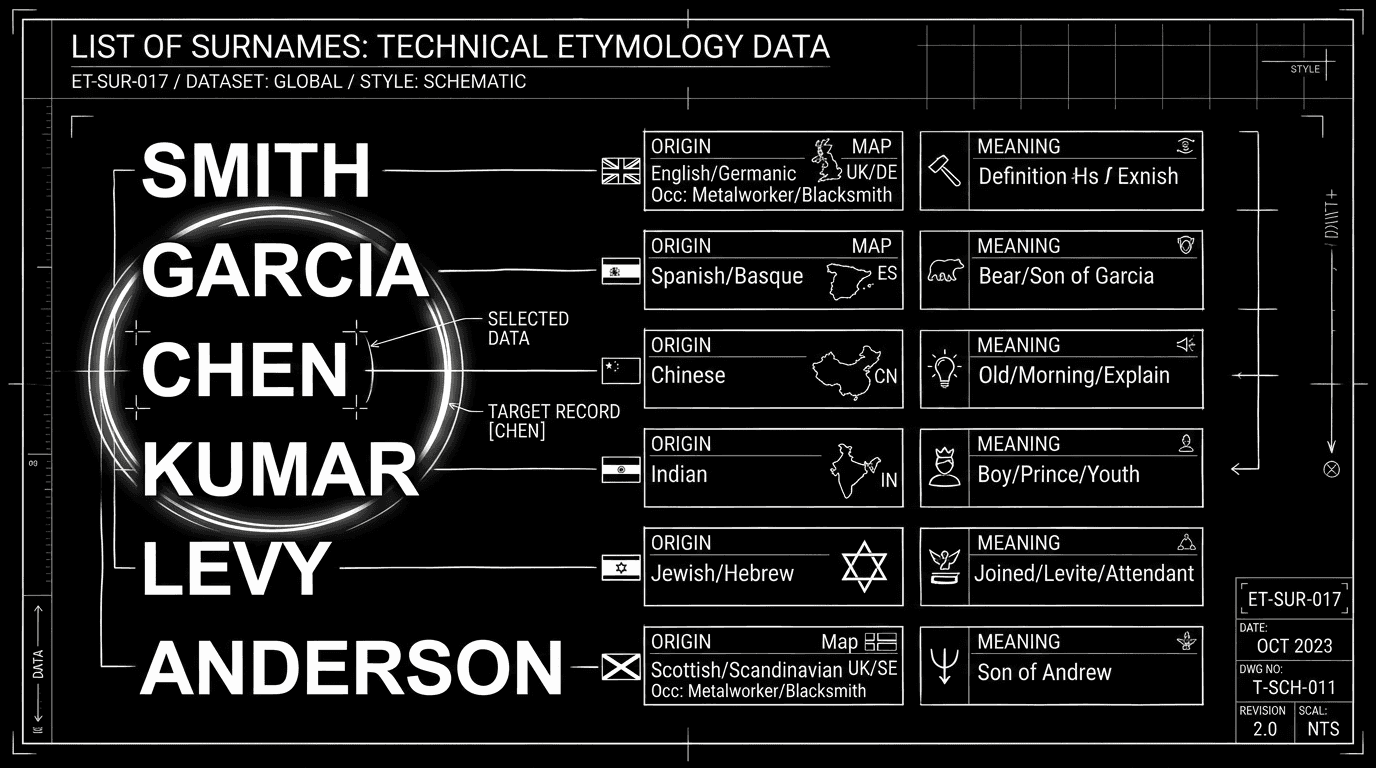
Software and parameters. Use any chat-style LLM. Prompts should include: type (surname), constraints (sound, meaning, origin, era), and quantity (20–30). Ask for "brief etymology or meaning" so you can verify. Temperature 0.7–0.9 for variety. For period accuracy, pair with a human-checked name resource. For more on character design and voice, distinct voices in ensemble and character foils extend the work you do once the name is set.
One External Reference
Etymology and naming conventions are documented in linguistic and historical sources rather than by AI vendors. Sites like Behind the Name{rel="nofollow"} offer searchable surname origins; use them to verify any meaning you care about before locking the character name.
The Perspective
AI doesn't name your character. It gives you a list of names that match the brief, etymology, sound, era, culture. You verify what matters, say the finalists aloud, and pick the one that fits. The machine expands the menu. You choose the plate.
Final Step
Build your next script with Screenweaver
Move from ideas to production-ready pages faster with timeline-native writing and AI-assisted story flow.
Try Screenweaver