
You have the rights. You have the book. Now you need the movie, or the limited series. The novel has subplots, digressions, and a hundred characters. The script has 15–25 major beats and a handful of characters who can carry the weight. Someone has to do the condensing. That someone is you. The question is whether an LLM can do the first pass: read (or summarize) the novel and output a 15-point beat sheet that you can then correct, cut, and own. Not a script. A beat sheet. The machine can't decide what the "real" story is. It can propose a shape. You decide if that shape is right, and you fix it until it is.
The AI doesn't adapt the novel. It drafts a possible skeleton. You're the one who knows which thread is the spine and which threads get cut.
Here's the tension. A 400-page novel can't be pasted into a chat window. So the workflow is always mediated: you work from a summary, from chapter summaries, or from chunks. You (or a tool) produce a structured summary of the book, plot, main characters, major turns. You feed that into an LLM with a clear instruction: "Reduce this to 15 story beats. One sentence per beat. Chronological. Only the main throughline; no subplots unless essential." You get a list. It will be wrong in places. It will include beats that don't belong in the film. It will omit beats that do. Your job is to edit the list. Add, cut, reorder. The 15-point beat sheet that goes into the room is yours. The machine gave you a first draft. You turned it into the map.
Cinematic workflow frames
These two visuals work as a pair: the first shows Cinematic workflow still, first angle, 35mm film grain, and the second shifts to Cinematic workflow still, second angle, 35mm film grain - compare them briefly, then move on.

Why 15 Beats (And Why Not the Whole Novel)
Fifteen beats is a working number. It's enough to cover setup, inciting incident, act breaks, midpoint, crisis, climax, and resolution, with a few beats to spare for key turns. It's not enough to hold every subplot. So the act of reducing to 15 forces choices. What's the single throughline? Who's the protagonist of the film (sometimes different from the novel's)? What has to happen so the audience gets the story? The novel can have 40 important scenes. The beat sheet has 15. The AI can propose a reduction. It can't know which 15 matter most for your adaptation. You do. So the output is a proposal. You're the editor.
The Workflow: From Novel to Beat Sheet Draft
Step 1: Create a structured summary of the novel. If you can't paste the whole book, you need a stand-in. Options: (a) Write a 2–5 page plot summary yourself (chapter by chapter or act by act). (b) Use an LLM to summarize the novel in chunks (e.g. by part or chapter), then combine into one summary. (c) Use an existing synopsis or treatment if you have one. The summary should include: main character(s), central conflict, major plot turns, and ending. The more accurate the summary, the better the beat sheet draft.
Step 2: Define the 15-beat format. Tell the LLM what you want. "15 story beats. One sentence per beat. Chronological order. Only the main plotline. Protagonist is [X]. The throughline is [Y]. No subplots unless they directly affect the main story." You can also specify a structure: "Beat 1: opening image. Beat 2: setup. Beat 3: inciting incident…" so the model maps the novel to a known shape. The instruction set shapes the output.
Step 3: Run the prompt. Paste the summary (or the full instruction plus summary). Ask for "15 story beats for a feature adaptation. One sentence each. Main throughline only." You get a numbered list. Read it. It will mix good choices with bad. Some beats will be from a subplot. Some key moments will be missing. That's expected. The draft is a starting point.
Step 4: Edit the list. Add beats that are missing. Remove beats that belong to subplots you're cutting. Reword so each beat is clear and actionable. Reorder if the chronology or emphasis is wrong. The final 15-beat sheet is your document. You've made every cut and every keep. The AI proposed; you decided.
Step 5: Use the beat sheet as the spine. You now have a 15-point map. Write the script from that map. When you're tempted to bring back a novel beat that isn't on the list, ask: does it serve the 15? If not, it stays in the book. The beat sheet is the contract between the novel and the script. You built it. You enforce it.
| You provide | LLM returns | You do |
|---|---|---|
| Novel summary (or chunked summary) + instruction for 15 beats | Numbered list of 15 one-sentence beats | Edit: add, cut, reorder, reword |
| Protagonist and throughline | Draft beat sheet aligned to that spine | Correct errors; lock the 15 |
| Optional: beat names (inciting incident, midpoint, etc.) | Draft mapped to that structure | Fill gaps; trim excess |
For structure that keeps beats and script in sync as you write, beat boards and script help. To map page targets to Save the Cat-style beats after you lock your 15, use the free Beat Sheet Calculator and Screenplay Outline Builder. For the broader craft of adaptation, theme vs plot and sequence method support the choices you make when reducing a long story.
Relatable Scenario: The Bestseller With Three Plotlines
The novel has a present-day thread, a flashback thread, and a secondary character's thread. You need one throughline for the film. You summarize the book in three sections (one per thread). You prompt: "From this summary, extract 15 beats for a feature film. The protagonist is [present-day character]. The throughline is [their arc]. Include only beats from the main thread and the flashback if they directly affect the protagonist. Omit the secondary character's thread." You get 15 beats. Three of them are still from the wrong thread. You cut those and add three from the main thread that were missing. You now have a 15-beat sheet that matches the film you want to write. The AI did the first pass. You did the adaptation choices.
Try it free
Try Screenweaver for free on your script
It is free. Import your existing project, get a clearer view of your outline, and regain control of your story structure in minutes.
Start FreeRelatable Scenario: The Network Wants a Beat Sheet by Monday
You've optioned the book. The network wants to see the shape before you write the pilot. You don't have time to hand-build a beat sheet from 400 pages. You create a 5-page summary (your own or from chunked LLM summaries of the book). You run the 15-beat prompt. You get a draft in an hour. You spend the weekend editing: fixing order, adding the twist they'll want to see, cutting the subplot that doesn't fit the format. You send 15 beats on Monday. They're yours. The machine compressed the book; you made the creative decisions.
Relatable Scenario: The Beat Sheet That Feels Generic
The LLM returned 15 beats that could apply to any thriller. You've lost the book's specificity. You go back to the summary. You prompt again: "Same 15 beats, but each beat must include one specific detail from the novel that makes this story unique, a character choice, an image, or a turn that's only in this book." You get a revised list. You merge it with your first edit. The beat sheet now has the novel's fingerprint. The AI gave you two passes: one for shape, one for specificity. You combined them.
What Beginners Get Wrong: The Trench Warfare Section
Pasting the whole novel and asking for 15 beats. Context limits and noise mean the model will miss or hallucinate. The fix: work from a summary. Create a 2–5 page plot summary (your own or from chunked summaries). Feed the summary into the beat-sheet prompt. You get a cleaner draft.
Accepting the first 15 as final. The first draft will include wrong beats and omit right ones. The fix: treat the output as a proposal. Edit every beat. Add, cut, reorder. The locked beat sheet is your document.
Not specifying protagonist and throughline. The novel might have multiple candidates. The model will guess. The fix: in the prompt, state who the film's protagonist is and what the central throughline is. "Protagonist: X. Throughline: her quest to find Y. Only include beats that serve this."
Including subplots because the model did. The model might add a beat from a subplot. The fix: when you edit, ask of each beat, "Is this part of the main throughline?" If not, cut it and replace with a beat that is.
Skipping the specificity pass. A beat sheet that could be any story isn't useful. The fix: after you have 15 beats, check that each has at least one detail that's specific to this novel. If not, reword or add. The beat sheet should feel like the book, compressed.
Using the beat sheet as the script. The beat sheet is a map. The script is the territory. The fix: write from the beats, but allow yourself to discover scene-level moments that aren't on the list. The list guides; it doesn't straitjacket. If you find a better beat while writing, update the list.
[YOUTUBE VIDEO: Walkthrough: taking a 2-page novel summary, running the 15-beat prompt, then editing the list, adding one beat, cutting two, reordering, and showing the final beat sheet as the spine for the script.]
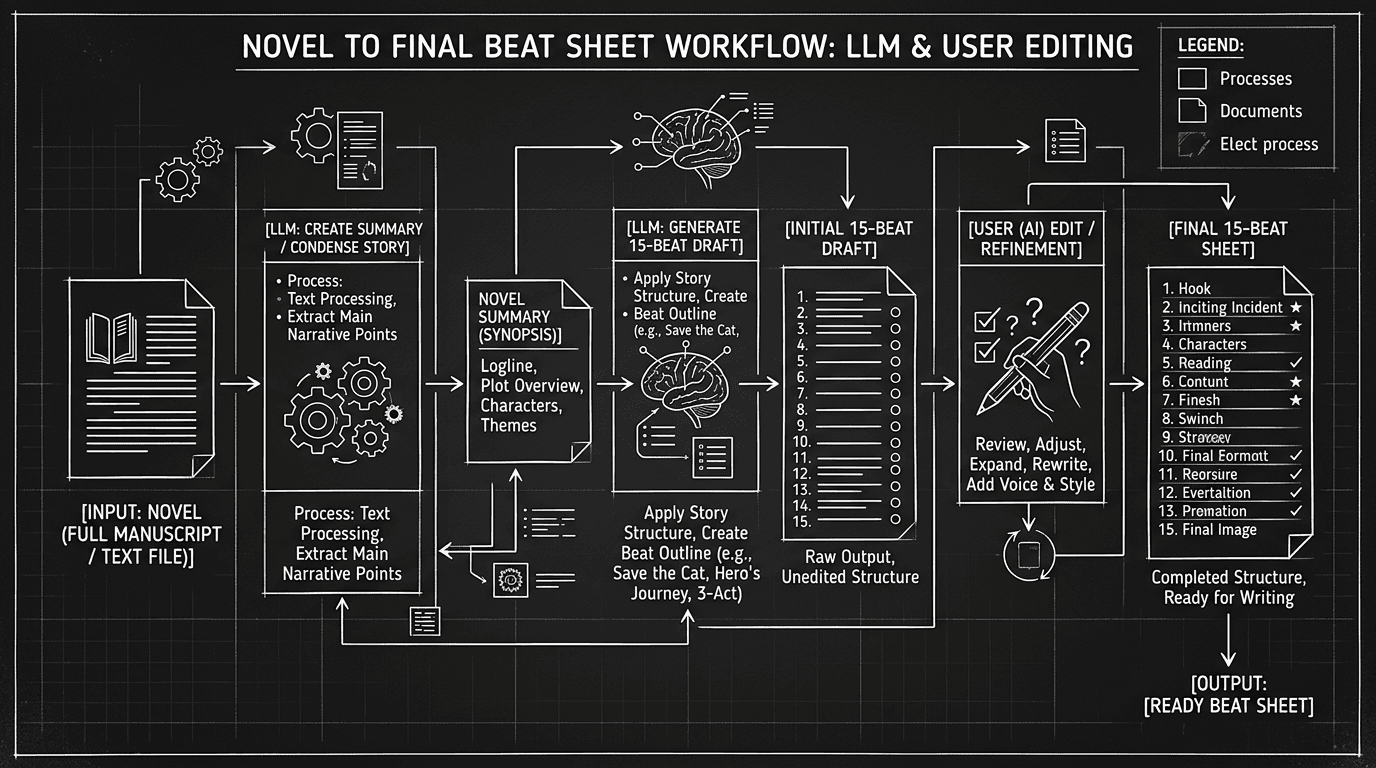
Software and parameters. Use an LLM with a large context window. Input: a 2–5 page plot summary (or the maximum the window allows). Instruction: "Reduce to 15 story beats for a feature adaptation. One sentence per beat. Chronological. Main throughline only. Protagonist: [X]. Throughline: [Y]." Temperature 0.3–0.5 for consistency. Output: numbered list. Then edit in a doc. For more on beat structure and script, beat boards and sequence method extend the same discipline: structure first, then pages.
One External Reference
Adaptation rights and credit are governed by contract and guild rules. The WGA{rel="nofollow"} and your agreement define who is the writer of the adaptation; using AI to draft a beat sheet doesn't change the need for you to make the creative choices and own the final document.
The Perspective
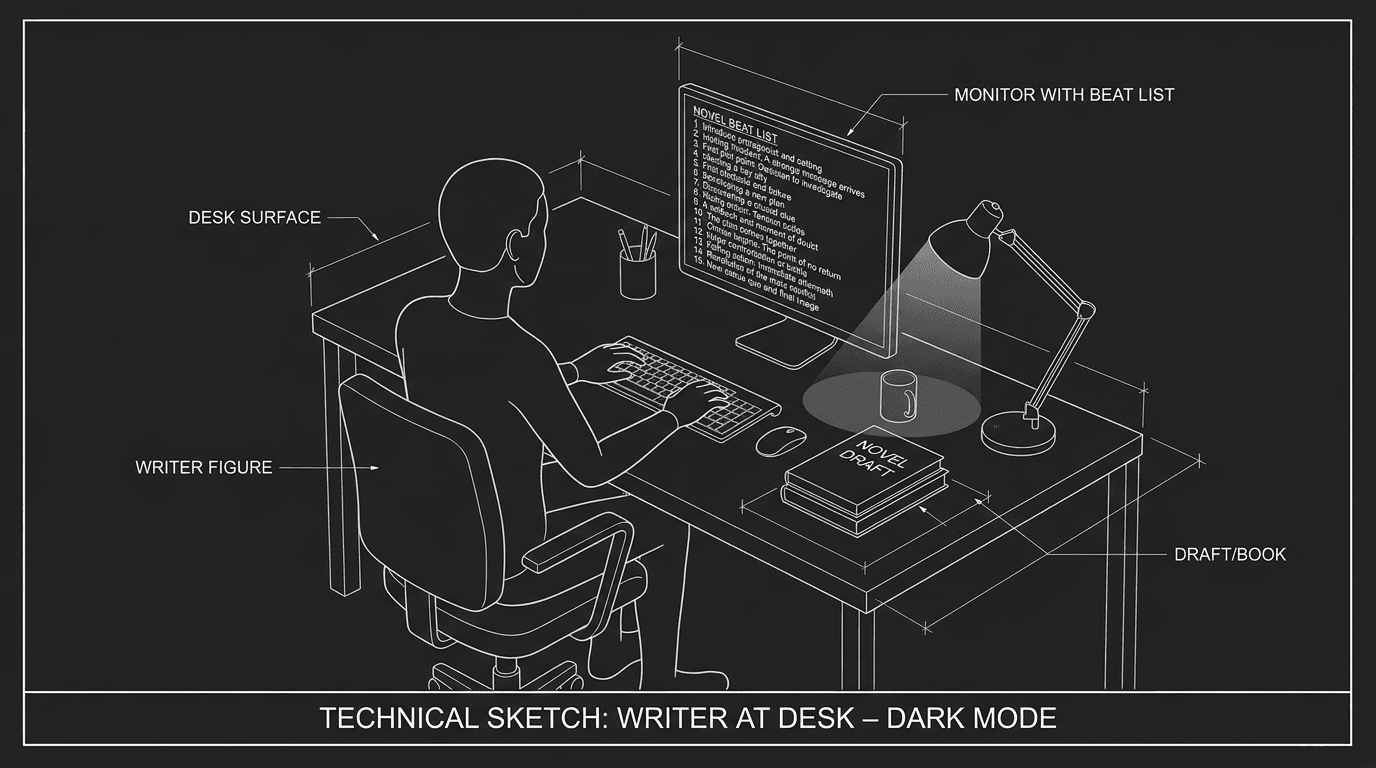
AI can condense a 400-page novel into a 15-point beat sheet, once the novel is in a form the machine can read (a summary). The output is a draft. You edit it. You add, cut, reorder, and lock the 15. That beat sheet is the spine of the adaptation. The machine compressed. You chose. The script that follows is yours.
Final Step
Build your next script with Screenweaver
Move from ideas to production-ready pages faster with timeline-native writing and AI-assisted story flow.
Try Screenweaver