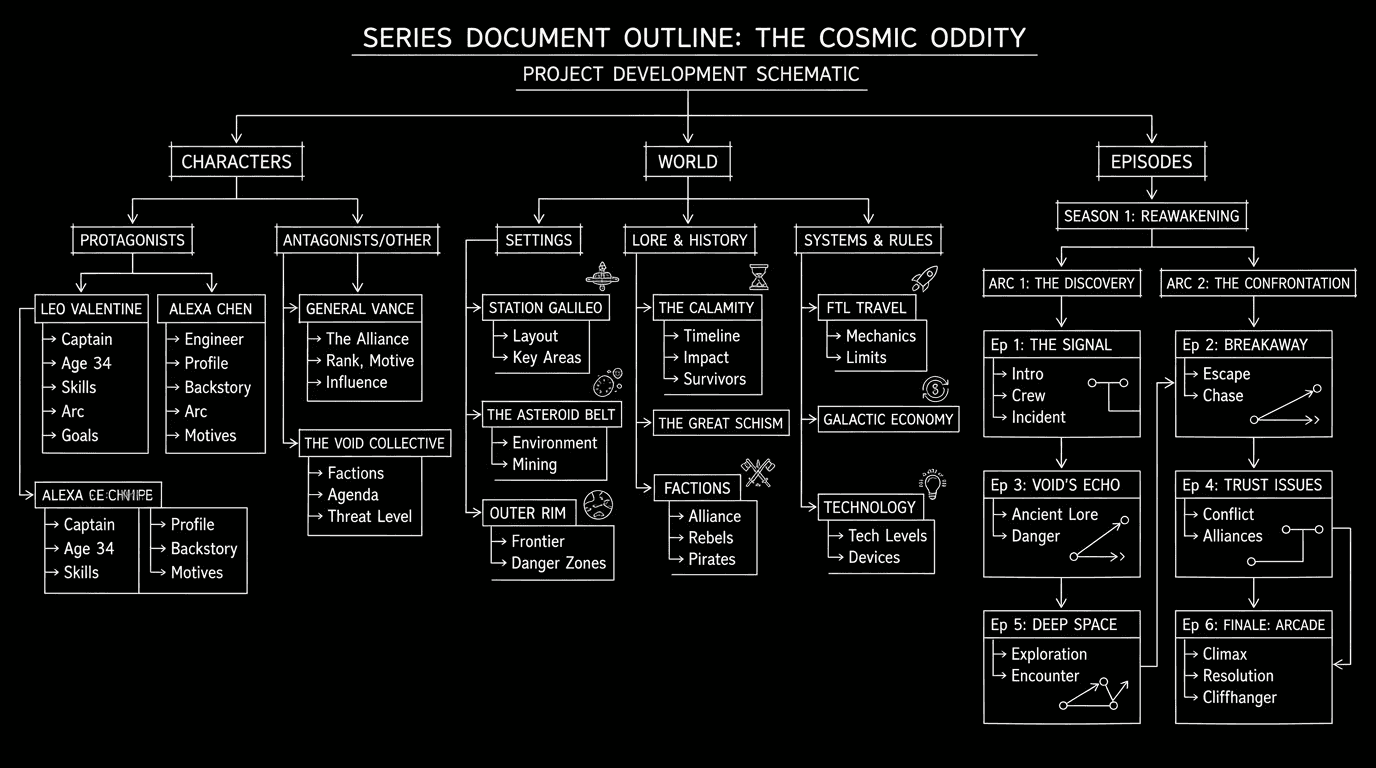

The series bible is the document that holds the show together. Characters, world rules, tone, episode summaries, and the arc of the season. You've got it all, in your head, in scattered notes, in the pilot script. Turning that into a single, navigable document can take days. The writing isn't the hard part. The organization is. Who appears in which episode? What's the rule about the magic system? When did we establish that detail? Algorithmic organization, using structure and, where useful, AI to sort, tag, and surface, can compress that work. Not by generating the content from scratch, but by turning your existing material into a bible that's easy to build and easy to search.
The 10x isn't in the machine writing the bible. It's in the machine helping you place every piece in the right section, cross-reference, and fill in the template so you're editing instead of assembling from zero.
Here's the tension. A series bible has to be accurate and consistent. If the AI invents a character detail or an episode beat, the bible is wrong. So the safe workflow is: you (or the room) produce the raw material, character bios, episode breakdowns, world rules. The algorithm (or an LLM following strict instructions) does the structuring: putting each piece in the right section, generating a table of contents, building character–episode matrices, and maybe drafting short summaries from your bullet points. You review every page. You own the content. The machine owns the filing and the first pass at organization. That's where the speed comes from. You're not writing the bible from a blank page. You're filling a template that's already wired to your material.
Cinematic workflow frames

These two visuals work as a pair: the first shows Cinematic workflow still, first angle, 35mm film grain, and the second shifts to Cinematic workflow still, second angle, 35mm film grain - compare them briefly, then move on.

What a Series Bible Usually Contains (And Why It's Slow to Build by Hand)
A typical bible has: Series overview (logline, tone, format). Character section (main cast with bios, arcs, relationships). World / rules (setting, period, any magic or tech rules). Episode list (number, title, one-paragraph summary, sometimes key beats). Ongoing threads (B-plots, mysteries, recurring themes). Appendix (timeline, glossary, cast list by episode). When you build this by hand, you're constantly flipping between the pilot, your notes, and the doc. You forget where you put something. You duplicate. You miss a character's first appearance. Algorithmic organization means: you feed in the sources (script, outlines, notes). The system (or a carefully prompted LLM) extracts entities (characters, locations, terms), assigns them to sections, and builds indices. You get a first draft of the bible structure with your content in the right buckets. You polish and correct. The 10x is in the first draft taking hours instead of days.
The Workflow: From Scattered Material to Structured Bible
Step 1: Gather and label your sources. Export or paste: pilot script (or key scenes), episode breakdowns if you have them, character notes, world-building notes. Label each (e.g. "Pilot script," "Character list v2," "World rules"). The more structured the input, the better the output. If you have a beat sheet or episode grid, include it.
Step 2: Define the bible template. List the sections you want: Overview, Characters, World, Episodes, Threads, Appendix. For each section, define what belongs there. E.g. Characters: name, role, one-line, bio, first appearance, key relationships. Episodes: number, title, logline, summary, key characters. You're building a spec. The LLM or tool will fill the spec from your material.
Step 3: Run extraction and placement. If using an LLM: "Here are my sources. [Paste or summarize.] Extract all character names and any stated details. Output a table: Character / Details / Source. Then assign each to the Character section and draft a one-line bio from the details." Or: "From the episode breakdowns, create the Episode section with number, title, one-paragraph summary." You run multiple prompts (one per section) so you can review each. If using a dedicated tool, you upload sources and the tool populates the template. Either way, you're generating structure and first-draft content from your material, not from thin air.
Step 4: Build cross-references. "Which characters appear in each episode?" "Which episodes establish the magic rule?" You can prompt: "From the character list and episode summaries, output a matrix: rows = characters, columns = episodes, cell = appears (Y/N) or role." That matrix becomes a page in the bible or a reference for the writers' room. Again, the source is your material. The algorithm assembles the view.
Step 5: Review and lock. Go through every section. Correct errors, add missing details, remove anything the model invented that isn't in your sources. The bible is now the single source of truth. Export to PDF or keep it live. Update it when the room breaks new episodes or when you change a rule. The first build was fast because the machine did the filing. The ongoing updates are still your job, but you're editing a doc, not building it from scratch again.
| Phase | You do | Algorithm / LLM does |
|---|---|---|
| Input | Gather script, notes, breakdowns; define template | , |
| Extract | , | Pull characters, locations, rules, episode beats from sources |
| Place | , | Fill each section of the template with extracted or summarized content |
| Cross-ref | , | Build character–episode matrix, indices |
| Review | Correct, add, delete; own every word | , |
For keeping outline and script in sync as the series grows, beat boards and script in one place supports that. For one-pagers and pitch materials, one-pager and pitch deck is related.
Try it free
Try Screenweaver for free on your script
It is free. Import your existing project, get a clearer view of your outline, and regain control of your story structure in minutes.
Start FreeRelatable Scenario: The Room Has Notes Everywhere
You've got a pilot script, a Slack thread of character ideas, and three different episode breakdown docs. Nobody has time to merge them into one bible. You paste the pilot (or its character and scene list), the Slack summary, and the breakdowns into an LLM. You say: "Create a series bible structure. Characters section: from these sources, list every named character with one-line description and source. Episodes section: from the breakdowns, one paragraph per episode. World section: extract any rules or setting details mentioned." You get a 15-page draft in one session. It has errors (the model conflated two notes). You fix those. You add the tone and overview yourself. The room now has a first draft to work from. The 10x was in turning scattered input into one document in an afternoon instead of a week.
Relatable Scenario: The Network Asks for a Bible by Friday
You have the material. You don't have the formatted document. You define the exact sections the network expects (often they have a template). You run extraction and placement for each section using your script and outlines. You get a draft that follows the template. You spend Thursday and Friday fact-checking and polishing. You deliver. Without the algorithmic pass, you'd be building the doc from scratch on Tuesday and would be late or exhausted. With it, you're editing. That's the 10x: same quality, less assembly time.
Relatable Scenario: Keeping the Bible Updated
After Season 1, you add new characters and episodes. You don't want to retype the whole bible. You add the new material (new script, new breakdowns) and run the same extraction and placement for the new sections only. You merge the new character list and new episode rows into the existing doc. The algorithm keeps the format consistent. You review. The bible stays the single source of truth without a full rebuild.
What Beginners Get Wrong: The Trench Warfare Section
Letting the LLM invent content. If you ask for "a series bible" without pasting your material, the model will make up characters and episodes. The fix: always provide the sources. The output should be derived from your script and notes, not from the model's imagination. "Extract from the following" is the key phrase.
One giant prompt for the whole bible. Context limits and complexity mean the model will skip or summarize too much. The fix: run section by section. Characters first. Then world. Then episodes. Then cross-ref. You get better accuracy and you can review each part before moving on.
Skipping the review pass. The first draft will have errors: wrong character in wrong episode, duplicated entries, invented details. The fix: treat the output as a draft. Every section gets a human pass. The 10x is in the draft; the quality is in the review.
No template. If you don't define sections and fields, the output will be inconsistent. The fix: write a short spec. "Character section: name, role, bio (2–3 sentences), first appearance (episode/scene)." Then prompt to fill that spec. You get a usable structure.
Forgetting to build cross-references. A bible is useful when you can ask "who's in Episode 4?" and "when did we establish X?" The fix: add a step that builds a character–episode matrix or an index. Prompt: "From the character list and episode summaries, create a table: character × episode, indicate presence or role." That becomes a page in the bible.
Updating by hand forever. Once the bible exists, don't rebuild it from scratch when you add an episode. The fix: add new material, run extraction for the new content only, and merge into the existing doc. The algorithm stays in the loop for updates too.
[YOUTUBE VIDEO: Demo: pasting pilot character list and three episode breakdowns into a chat, running section-by-section prompts to build Overview, Characters, World, Episodes, then generating a character–episode matrix and exporting to a doc.]
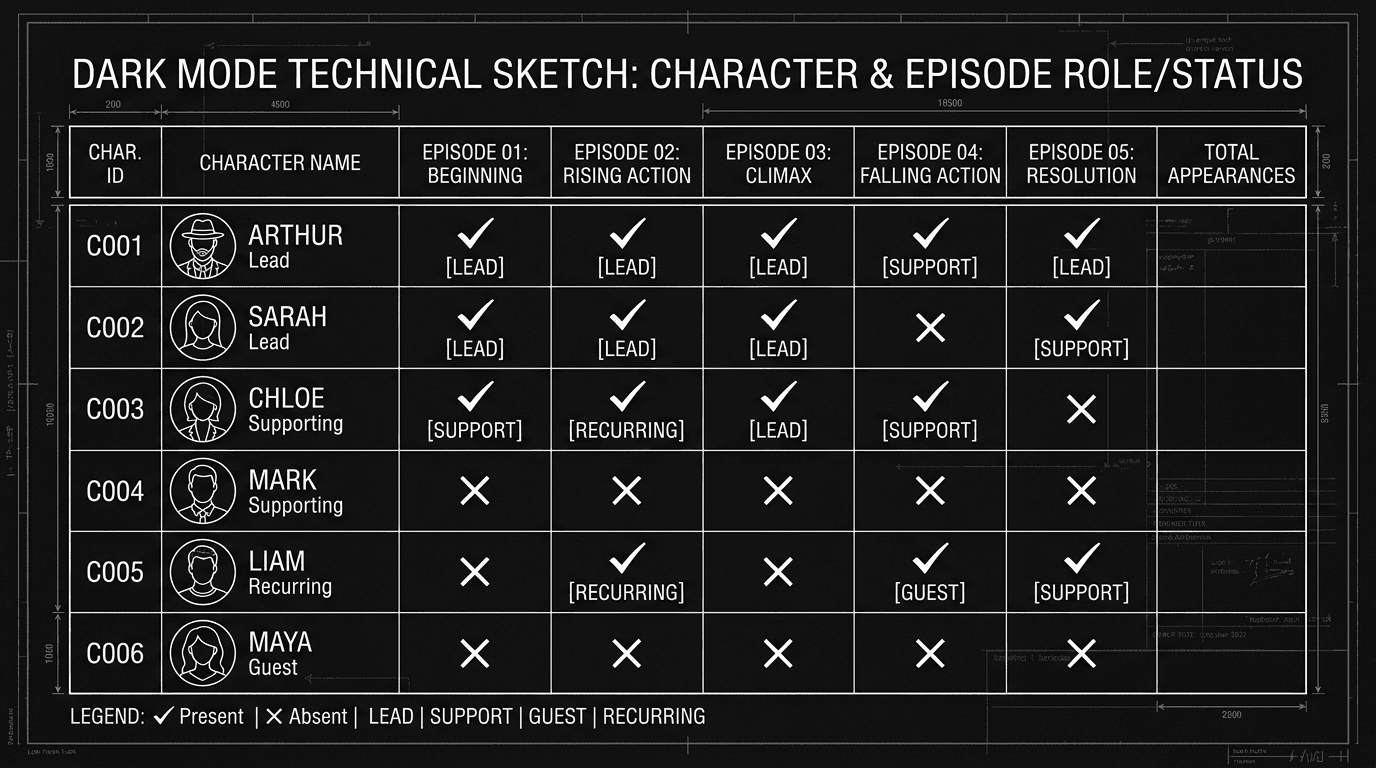
Software and parameters. Use any LLM with a large context window. Provide clear instructions: "Extract only from the following. Do not add information not present in the sources." Use section-by-section prompts. Temperature 0.3–0.5 for extraction (accuracy over creativity). For cross-ref tables, ask for markdown or CSV so you can paste into a doc or sheet. For more on structure and script together, beat boards and outline and one-pager for your show extend the same idea: structure first, then fill.
One External Reference
Industry templates for series bibles vary by studio and platform. The WGA{rel="nofollow"} and producer resources sometimes reference standard elements; your algorithmic pass should output a structure that matches what buyers and production expect, with content drawn from your material only.

The Perspective
The 10x in generating a series bible faster isn't the machine writing the show. It's the machine doing the filing: extracting from your script and notes, filling the sections, building the indices. You supply the material. You review and own every word. The algorithm turns scattered input into a first draft in hours. You turn that draft into the bible the room and the network can use.
Final Step
Build your next script with Screenweaver
Move from ideas to production-ready pages faster with timeline-native writing and AI-assisted story flow.
Try Screenweaver