

Writing Faith-Based Films: Understanding the Market
If you walk into a multiplex on a Friday night and scan the showtimes, faith-based films rarely scream for attention. No superhero logos. No massive IP brand. Just a handful of earnest titles that look, at first glance, “small.”
Then you look at the numbers. Modest budgets. Strong per‑screen averages. Repeat attendance. And, every few years, a breakout that blindsides the town.
This is the strange paradox of the faith-based market: it’s both invisible and incredibly loyal. If you want to write in this space, you can’t treat it like “discount drama with some Bible verses.” You’re writing for one of the most values‑driven, word‑of‑mouth‑powered audiences in cinema.
Here’s why that matters for your pages.
What “Faith-Based” Really Means (And What It Doesn’t)
Studios and streamers use “faith-based” as shorthand, but it’s not a single genre. It’s a cluster of overlapping expectations around worldview, tone, and representation of belief.
Some faith‑based films are overtly evangelical. Some are ecumenical or broadly spiritual. Some barely mention God and are still marketed through churches and ministry partners because of underlying themes of redemption, forgiveness, or sacrifice.
If you’re going to write for this market, you need to get specific. “Faith” is not a character trait. It’s a lived set of choices. It shapes what your characters can do on screen, what they struggle with, and how they resolve conflict.
The worst mistake beginners make is treating faith as a prop. A cross necklace. A quick prayer in Act Three. A throwaway line about going to church. The market spots that instantly. So do the people reading for faith‑friendly distributors.
If belief doesn’t cost your character anything, the story won’t feel faith-based. It will feel faith‑flavored.
That distinction is everything. Faith-flavored scripts might sell somewhere. They rarely travel through church‑driven word of mouth, and that’s where this market truly lives.
The Real Audience: Who Actually Shows Up
Picture three different viewers:
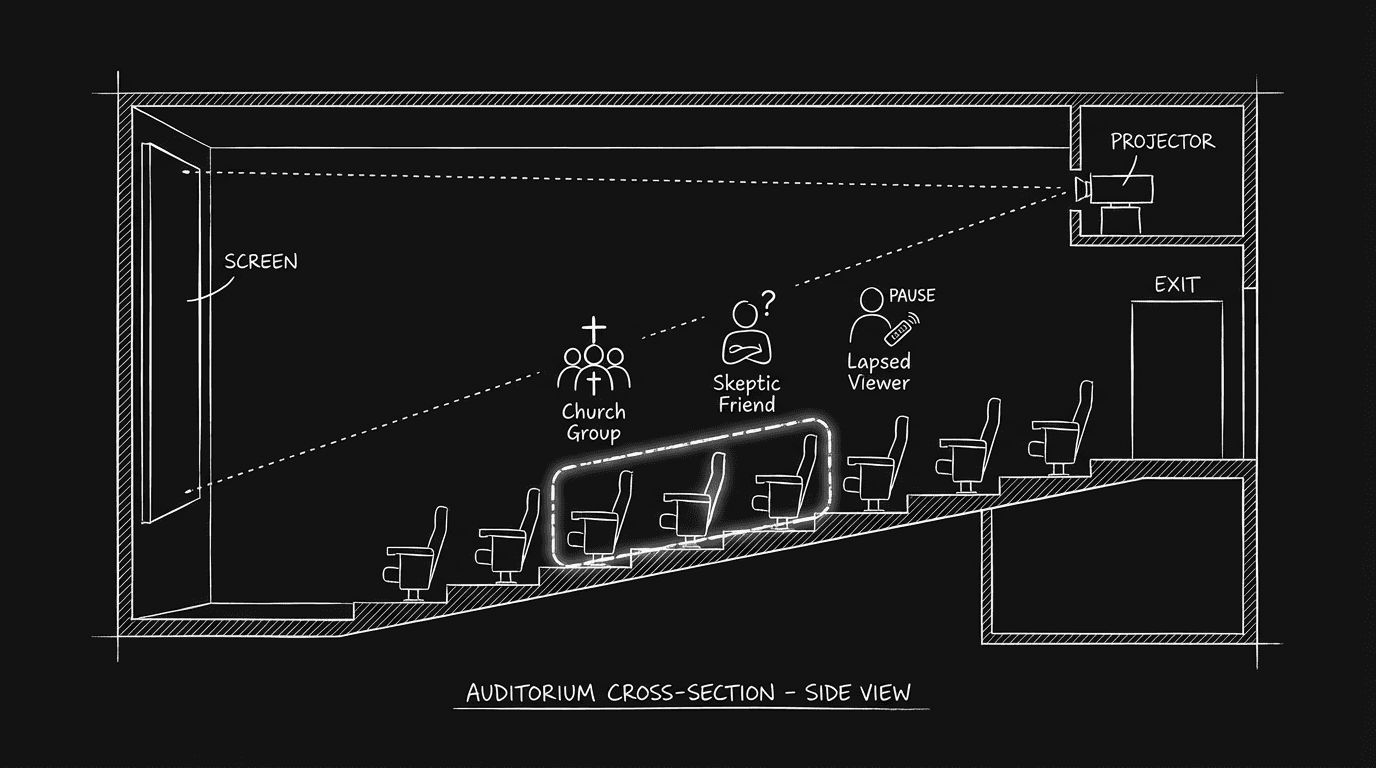
The first is a fifty‑five‑year‑old woman who leads a small‑group Bible study. She might bring ten people with her if she trusts your film.
The second is a thirty‑year‑old dad who doesn’t like “cheesy Christian movies” but will give one a shot if the trailer feels grounded and his pastor recommends it.
The third is a twenty‑two‑year‑old lapsed church kid scrolling Netflix, hovering over a thumbnail that looks surprisingly cinematic and not like a sermon in disguise.
All three are part of the same ecosystem. But they’re not looking for the same thing.
Here’s a simplified way to think about the main segments you’re writing toward:
| Audience Segment | Primary Hook | Dealbreaker |
|---|---|---|
| Church‑centric congregants | Clear moral message, safe content | Graphic sex/violence, open cynicism about faith |
| “Values but not churchy” | Emotional honesty, relatability | Preachiness, straw‑man skeptics, flat characters |
| Curious or lapsed viewers | Strong drama, cinematic storytelling | Simplistic answers, lack of nuance, “perfect” believers |
This table isn’t a formula. It’s a map of where you can push and where you can’t.
If you aim only at the first group, you may get screenings and church licensing, but your film might never travel outside the bubble. If you ignore them entirely, you may lose the most organized, mobilizable audience you have.
The best faith‑based scripts understand the tension. They give church‑centric audiences something they can invite people to without embarrassment while giving skeptical viewers enough humanity and conflict to take anything you say about God seriously.
Scenario 1: The “Message First” Writer
Let’s start in the trenches with a scenario that happens more than anyone admits.
Sarah is a youth pastor who’s watched every major Christian film of the last decade. She’s fed up with how teens are portrayed, either spotless saints or cartoonish rebels. One night, after a rough counseling session with a student, she decides she’s going to write “the real one.” A movie that tells the truth about faith and doubt.
She opens her screenwriting app and starts on page one with a Bible verse. Then a sermon voice‑over. Then a montage of her teen protagonist doing everything “wrong” before a big conversion finale.
By page 40 she’s exhausted. The script reads like an illustrated tract. The characters are thin. Every scene is bent into a moral.
This is the “message first” trap.
Sarah’s instinct, to care about what the film says, is right. But faith‑based audiences don’t reward message at the expense of humanity. They reward stories that feel honest about how hard belief can be.
If you recognize yourself in Sarah, your fix isn’t to abandon the message. It’s to relocate it.
Instead of asking, “How do I preach this idea?”, ask, “Who is the one person for whom this belief is painfully hard, and what would it cost them to live it?”
That’s a protagonist. That’s conflict. That’s cinema.
Scenario 2: The “Crossover” Writer Who Accidentally Alienates Everyone
Now flip it.
Jordan is a secular screenwriter who sees an opportunity. Faith-based films, he figures, are “low‑hanging fruit.” Lower budgets, less competition, clear buyers. He decides to aim for a crossover movie that will please both believers and nonbelievers and, in practice, pleases no one.
He writes a polished character drama about a burned‑out lawyer returning to his hometown. There’s a church in the background, a funeral scene, a pastor who gives some wise advice. But Jordan is wary of “going too religious,” so any time the story approaches prayer, or Scripture, or a character’s actual experience of God, he pulls back.
The film lands in a weird middle lane. Too mild for faith‑centric distribution. Too dependent on church culture to travel widely as a general drama.
The lesson here isn’t that you have to be a believer to write faith-based films. It’s that you can’t treat faith as window dressing. If you build your world around a church, that church’s beliefs are going to shape the choices your characters make.
You don’t have to endorse those beliefs personally. You do have to understand and dramatize them from the inside.
Market Reality: Budgets, Windows, and Where These Films Live
Faith-based films sit in a very particular part of the industry. Budgets are usually modest compared to studio genre fare. What they trade for scale in spectacle, they aim to recover through:
Theatrical runs that front‑load attendance through church partnerships and advanced group sales.
Event‑based screenings, often limited‑run, that cluster box office into a few nights.
Digital and streaming windows where the film becomes small‑group or family‑night viewing.
If you study the box office histories of faith‑driven titles (start with public resources like this breakdown of religion‑adjacent box office trends{rel="nofollow"}), a pattern appears: the biggest hits are rarely surprises to the communities they’re built for. They’ve been nurtured through churches, influencers in the faith space, and targeted campaigns long before opening night.
Your script needs to be built for that ecosystem.
What does that mean in practice?
It means writing for group viewing. Scenes that invite post‑film discussion. Dilemmas that ministers can hang a sermon on. Climaxes that feel like catharsis, not just plot resolution.
It also means being realistic about content thresholds. Many faith‑centric distributors have internal guidelines about language, sexuality, and violence. You don’t have to sterilize everything, and there’s a growing appetite for grittier, more grounded stories, but you do need to know who you’re pitching and where their lines are.
Core Story Types in Faith-Based Cinema
Even if faith-based films aren’t a genre, certain narrative shapes show up again and again. If you understand these shapes, you can either use them deliberately or bend them in smarter ways.
1. Conversion or Re‑Commitment Arc
This is the classic “I was lost, now I’m found” structure. A character begins far from faith, hits bottom, encounters some form of grace, and turns toward belief.
On paper, it sounds straightforward. On screen, it often feels thin because writers rush the internal shift. They treat the character’s spiritual journey like a light switch.
If you’re writing a conversion story, map the inner beats as carefully as you would a romance or a thriller. What exactly is the lie your character believes about God, themselves, or the world? What evidence do they see that challenges that lie? Where do they resist? Where do they double down?
Faith doesn’t arrive in one speech. It emerges through a series of small, often painful surrenders.
2. Crisis of Faith
These stories start with a believer. A pastor whose prayer wasn’t answered. A worship leader whose child is sick. A missionary confronted with suffering that doesn’t fit their theology.
The market is hungry for these, because they reflect what many adults in the pews actually feel but rarely say out loud. Done well, crisis‑of‑faith stories can bridge church‑centric viewers and skeptics. Both recognize the problem. Both care how honestly you face it.
The risk is twofold: you can over‑sanitize the doubts, or you can wallow in despair without a path forward.
Your job isn’t to write a tidy theological treatise. Your job is to dramatize the collision between expectation and reality, then follow what that does to relationships, identity, and purpose.
3. Vocation and Calling
Here, the question isn’t “Do I believe?” but “What do I do with my life if I believe this?”
A doctor facing an ethical dilemma. An artist deciding whether to stay in a “secular” space. A business owner trying to live out integrity under pressure.
These stories can be extraordinarily cinematic because they externalize faith. You get moral stakes, professional stakes, and often reputational stakes all braided together.
If you come from a church context where “calling” is talked about a lot, be careful not to flatten it into one sermon scene. Calling is scary. It rarely arrives with full clarity. It asks a character to give something up.
Building a Faith-Based Protagonist Who Isn’t a Saint or a Straw Man
The most common complaint from faith-aware readers is that characters in these scripts don’t feel like people they know.
They feel like types: “the Atheist Professor,” “the Noble Pastor,” “the Party Kid Who Just Needs Jesus.” That’s not story. That’s propaganda.
To build a protagonist who actually lives on the page, start with three layers:
Their public faith. How they talk about belief in front of others. Church persona, social media, ways they reference God casually.
Their private faith. The doubts they only admit in prayer. The compromises they make when no one is looking. The questions they never bring up in small group.
Their practical faith. How belief shapes (or fails to shape) their calendar, spending, relationships, and career choices.
If all three layers say the same thing, if your pastor is exactly the same in the pulpit, at home, and in the boardroom, you’re not writing a human being. You’re writing an icon.
Give them discrepancy. Let there be a gap between what they say and what they do. The story is in that gap.
Granular Workflow: Designing a Faith-Based Script That Can Actually Be Marketed
Let’s talk practical. You sit down to break a faith-based feature. What does your workflow look like if you want the script to be both artistically alive and marketable?
Step 1: Define Your Core Question in Secular Terms
Before you write a single scene, phrase the movie’s spine as a question that doesn’t require religious language.
Not: “Will she find Jesus?”
But: “Can she forgive the person who wrecked her life?” or “Will he cling to control or risk vulnerability?”
Why? Because the broader industry, including some faith‑friendly producers, will evaluate your story primarily on that human spine. The spiritual language sits on top of it. If you can pitch the movie compellingly without mentioning God, you probably have a solid dramatic core.
Step 2: Map the Theology in the Background
Once you have that core question, sketch the theological framework your main characters inhabit. What kind of church? What denominational assumptions? What do they believe about suffering, success, miracles, sin, grace?
You don’t need to turn your script into a systematic theology. You do need to know what your characters think God is like, because that will dictate how they interpret events.
Is a setback “spiritual warfare,” bad luck, or a consequence of their own choices? Those interpretations will shape dialogue and decision‑making in ways savvy audiences pick up on.
Step 3: Beat Sheet with Explicit Faith Pressure Points
When you build your beat sheet, whether you’re using a three‑act structure, the story circle, or something more specialized, tag which beats directly pressure the character’s faith.
If you’ve read our guide on [The 3-Act Structure Demystified for Screenwriters], think of these as your spiritual equivalents of midpoint reversals and all‑is‑lost moments. Where does the character’s belief system work for them? Where does it fail? Where do they reinterpret what faith even means?
You don’t need to flood the script with sermons. You need a few precise, emotionally loaded beats where belief is on trial.
Step 4: Content Threshold Check
Before you ever send your script to a faith‑based producer, do a hard content pass.
What’s the highest level of on‑screen intimacy? How many instances of profanity, and what kind? How graphic is the violence? Are there depictions of substance abuse?
You can absolutely write grittier stories; a lot of modern faith‑centric viewers are begging for them. But if your film opens with an extended, explicit sex scene, most church licensing partners are gone before page 10.
Use a simple test: imagine a pastor deciding whether to take a youth group or small group to your film. Would they be blindsided by anything?
If the answer is yes, either adjust the execution or choose a different sub‑market (e.g., general arthouse drama with religious themes instead of faith‑market theatrical).
Step 5: Partner‑Friendly Moments
As you refine scenes, deliberately build a few moments that ministry partners can latch onto: a line that becomes a sermon illustration, a turn that invites discussion, an image that pastors will reference from the pulpit.
You’re not writing propaganda. You’re being strategic: the more your film gives faith leaders material to work with, the more likely they are to advocate for it.
Try it free
Try Screenweaver for free on your script
It is free. Import your existing project, get a clearer view of your outline, and regain control of your story structure in minutes.
Start FreeThe Trench Warfare Section: What Beginners Get Wrong
This is where most aspiring writers lose the battle. Not because they don’t care about faith, but because they misunderstand how it plays on screen and how the market responds.
Let’s walk through the most common failure modes and how to fix them.
Failure Mode 1: Sermon Scenes Masquerading as Drama
You’ve seen this one. A character sits across from a pastor, mentor, or wise friend. They briefly explain their problem. The mentor launches into a mini‑sermon. The character nods, maybe cries, and then the “issue” is resolved.
On a page level, it can even read well. Strong rhetoric. Clear theology. Emotionally sincere.
On a cinematic level, it’s dead. There’s no conflict. No discovery. No risk that the character might walk away unchanged.
To fix it, strip the scene down to active decision.
Instead of the mentor “explaining grace,” let the mentor reveal a secret that costs them something, forcing the protagonist to decide whether to extend grace in real time. Make the principle visible in action, not recited.
If you must include explicit theological language (and in many films you will), embed it in a moment of genuine vulnerability or argument. Let someone push back. Let there be the possibility that the conversation fails.
Failure Mode 2: Villainizing Doubt
Many scripts treat doubt as a simple moral failing. The doubter is the antagonist. The believer is the hero. The story’s job is to prove the doubter wrong.
This might briefly satisfy the least reflective part of your audience. It will repel anyone who has ever actually wrestled with belief.
Healthy, honest faith‑based films treat doubt as a natural part of spiritual life. The Psalms are full of it. So are most significant conversion narratives in religious history.
When you write a doubter, respect their intelligence. Give them real questions. Don’t load them up with clichés about “loving sin too much.” If they’re going to move toward faith, make that movement costly in a way that honors what they’re leaving behind.
Failure Mode 3: Sanitized Sin and Suffering
Out of fear of offending, some writers sand down the edges of every hard thing. Addiction becomes “bad habits.” Abuse becomes “mistakes.” Systemic injustice becomes “tough times.”
The result is a world no one recognizes. Faith, in that space, doesn’t look like a lifeline. It looks like a hobby.
You don’t have to linger on graphic detail. You do need to name things honestly. A marriage on the brink of collapse should feel like it. A prodigal child should not turn their life around after one polite conversation.
If your faith offers hope, let it offer hope in the face of something genuinely dark.
Failure Mode 4: One‑Dimensional Nonbelievers
If every non‑Christian in your script is angry, petty, or secretly miserable, your film stops being persuasive. It becomes a caricature.
In real life, many nonbelievers are kind, generous, morally serious people. Many believers are petty, jealous, or hypocritical. Drama lives in that mess.
Write at least one nonbelieving character your audience would actually like. Let them be competent. Let them be funny. Let their objections to faith land with some weight.
You’re not undermining belief by doing this. You’re making any eventual spiritual movement in the script feel like a choice, not an inevitability.
Failure Mode 5: Ignoring Denominational and Cultural Specifics
“Church” is not a monolith. A white suburban evangelical megachurch, a Black Pentecostal congregation, a small rural Catholic parish, and a Korean‑American Presbyterian church all have different rhythms, music, preaching styles, and internal politics.
When your script flattens all of that into “generic church,” it feels fake to everyone who’s actually spent time in one.
Pick a context. Do real research. Talk to people. Watch services online. Pay attention to how people dress, how they talk, when they stand and sit, what they care about in their neighborhoods.
Then let those specifics show up in small ways: the kind of potluck dishes, the way volunteers speak to each other in the lobby, the songs chosen for a funeral.
Failure Mode 6: Ending on a Theological Mic Drop Instead of a Human Resolution
Many beginner scripts end with a big speech that “explains” the point of the movie. A pastor preaches. A character testifies. The camera slowly pushes in. Music swells.
Then we cut to black.
You can absolutely have speeches; just don’t confuse them with resolution. Resolution is what your character does next week.
If you’ve read our deep dives on [Writing the Big Speech for Courtroom Dramas], you know the speech isn’t the real climax. The verdict is. The same holds here. When the credits roll on your faith‑based film, the audience should have a concrete sense of how the protagonist’s choices will change their daily life.
Show the amends they attempt. The habit they break. The risk they take. End on action, not just articulation.

Software, Tools, and the Long Tail of Faith-Based Content
Your faith-based film doesn’t live only in theaters. It lives in living rooms, youth rooms, and small‑group studies, often for years.
When you write, imagine the long tail. Imagine someone pausing your film mid‑scene to ask, “What would you do here?” Imagine a study guide writer pulling ten discussion questions from your third act alone.
From a workflow standpoint, it can help to:
- Annotate your own script: As you revise, mark scenes that contain natural discussion hooks, Scripture resonance, or themes a pastor might build a series on.
That one small habit changes how you stage conflict. You stop writing only for the two hours in the theater and start writing for the months of ongoing conversation after.
On the production and distribution side, pay attention to how faith‑oriented platforms and streamers present this content. Thumbnail design, genre tags, content warnings, and logline wording all send signals to the audience about what kind of “faith-based” they’re about to get.
If your script feels like a bait‑and‑switch, tonally light until a heavy sermon, or marketed as gritty but sanitized in practice, you’ll feel it in reviews and church feedback.
[YOUTUBE VIDEO: Behind‑the‑scenes breakdown of how a modern faith‑based feature is positioned from script to trailer to church campaign, including interviews with a screenwriter, producer, and pastor partner.]
Where Faith-Based Writing Intersects With Mainstream Craft
Here’s the encouraging news: almost everything that makes a great faith-based film also makes a great film, period.
You still need clear structure. You still need a protagonist with a sharp want, a meaningful wound, and a specific flaw. You still need escalating conflict, intelligent antagonism, and a climax that pays off setup.
What’s different is the axis of transformation. In a heist movie, the key question might be “Do they get away with it?” In a rom‑com, “Do they end up together?” In a faith‑based story, the underlying question is often “Who does this character become in light of what they believe, or stop believing?”
That doesn’t make faith stories smaller. It often makes them deeper.
If you’re used to writing big spectacle, you may initially feel constrained. You can’t rely on sex or graphic violence to jolt the audience. You’re often working at a smaller budget. You have to generate intensity from moral stakes and relational fractures.
Think about it this way: faith-based films are character labs. They’re where you stress‑test the most foundational beliefs a person holds and watch what breaks.
When you approach them with that level of seriousness, they stop being “a niche market you might as well try” and start being one of the most demanding, rewarding corners of screenwriting craft.
A Final Perspective: Respect the Audience or Don’t Bother
The faith-based audience is not stupid. They know when they’re being pandered to. They know when a script is using God as a convenient plot device. They also know when a writer has done the hard work of understanding their world, even if that writer doesn’t share every conviction.
The only unforgivable sin in this market isn’t doubt, darkness, or complexity, it’s condescension.
If you come in with respect, curiosity, and a willingness to put belief under real dramatic pressure, you’ll find collaborators. Pastors, producers, actors, and small‑group leaders are all looking for stories that take faith seriously enough to let it struggle.
And if you bring to that respect the same structural rigor you’d use for a genre spec or prestige drama, the same care for midpoint turns, climactic reversals, and visual storytelling you’d use in any other script, you won’t just be “writing Christian movies.”
You’ll be building stories that can hold their own on any screen, in any market, while still speaking directly to viewers for whom faith is not a subplot but the axis of their lives.
That’s the bar. Not “good for faith-based.” Just good. And if you can clear that bar consistently, you won’t need to chase the market.
It will come looking for you.
Final Step
Build your next script with Screenweaver
Move from ideas to production-ready pages faster with timeline-native writing and AI-assisted story flow.
Try Screenweaver