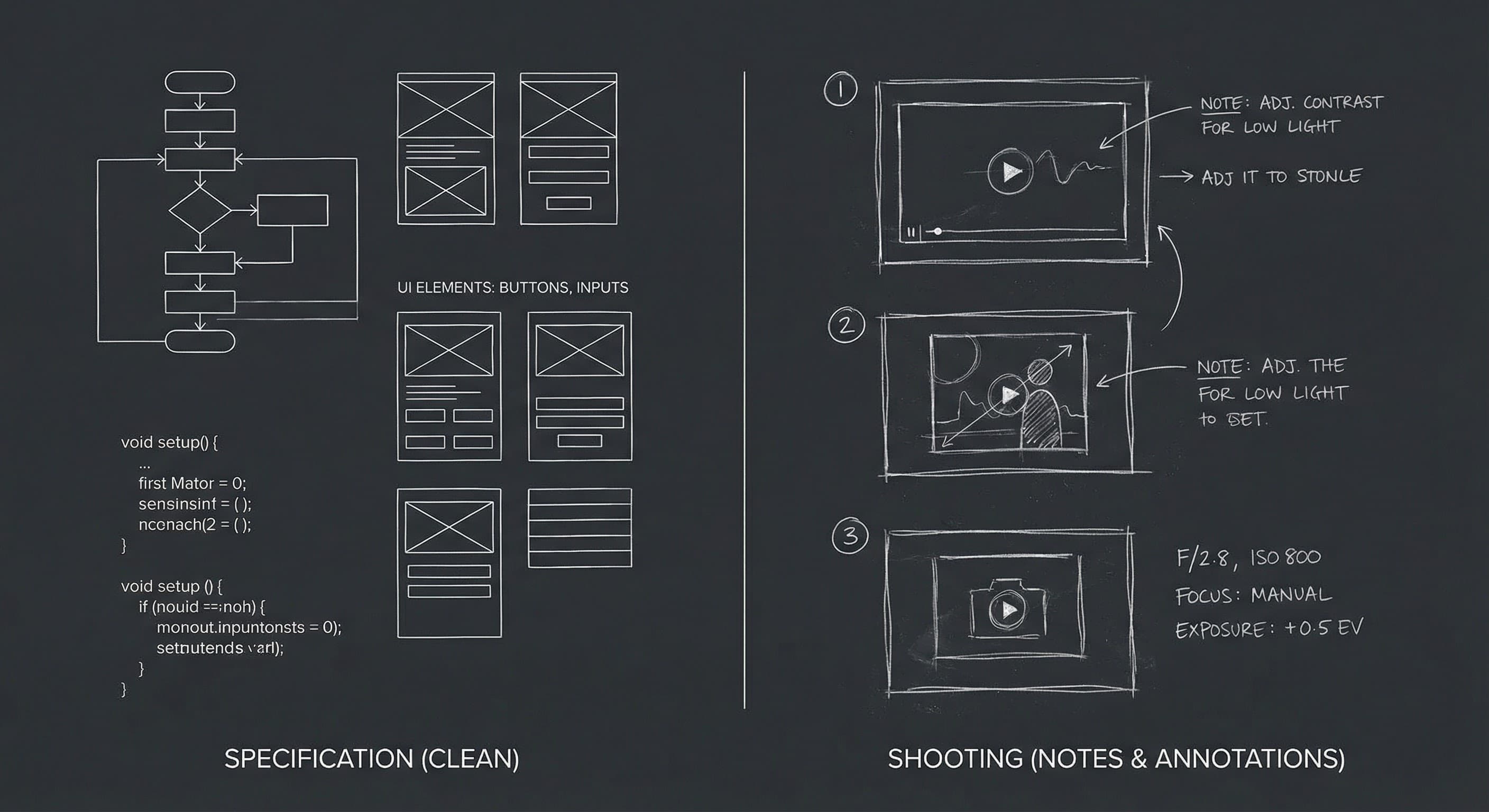

You hand in a script. It's clean. No scene numbers. No (CONT'D)s crowding the dialogue. It reads like a story. Then someone says they're sending it to the line producer. Next thing you see has numbers in the margin, revised pages, and a header that says "SHOOTING SCRIPT." It's the same story. It's not the same document. The spec is for selling and reading. The shooting script is for making the movie. If you don't know the difference, you'll hand in the wrong thing at the wrong time,or you'll get rewritten by someone who does.
Writers care about the spec. It's what gets you repped, staffed, and hired. Production cares about the shooting script. It's what gets scheduled, budgeted, and shot. They're two phases of the same story. Different rules. Different audiences.
What a Spec Script Is
A spec script is a screenplay written "on speculation",without a guaranteed buyer or production commitment. It's the version you use to get representation, to enter contests, to send to producers and development executives. Its only job is to be read. So it's optimized for clarity and flow. No scene numbers. No camera directions (or very few). No technical annotations. Just story, character, dialogue, and action. The reader should forget they're reading a script. They should see the movie.
Industry standard for spec format: 12pt Courier (or equivalent), roughly one inch margins, dialogue and action in the same font. Scene headings in caps. Character names in caps above dialogue. Minimal parentheticals. No binding except a single brad or a PDF. The goal is to look professional and stay out of the way. Anything that reminds the reader they're reading a blueprint,camera angles, lens choices, scene numbers,belongs in another phase. As we've covered in formatting phone calls and other technical choices, even in a spec you make formatting decisions that affect readability. But you're not yet making production decisions.
The spec script answers one question: would I want to see this movie? The shooting script answers another: how do we build it?
What a Shooting Script Is
The shooting script is the locked version used for pre-production and production. It has scene numbers. Every scene gets a number (1, 2, 3…) so that the schedule, the budget, the call sheets, and the edit can all refer to the same thing. "We're shooting scenes 24 and 27 today." That only works if the script is numbered. The shooting script may also include revised pages (with revision colors and dates), production notes, and sometimes more explicit technical direction. It's a working document. For how the people at the top of the food chain use these documents, see what a showrunner is and how you become one. It's been through development. It may have been rewritten by the director, the showrunner, or other writers. It's the version that gets broken down by the AD and the line producer. It's the version on set.
Writers don't usually create the first shooting script. The production office does. They take the approved script (often still in spec format), add scene numbers, and issue it as the shooting script. After that, any change generates revised pages. A new scene gets an letter suffix (24A). A omitted scene keeps its number but is marked OMITTED. The system keeps everyone on the same page,literally.
Side-by-Side: Why They Diverge
| Aspect | Spec script | Shooting script |
|---|---|---|
| Scene numbers | None | Every scene numbered |
| Revisions | N/A | Revision colors, dates, "Rev." in header |
| Camera / technical direction | Avoided or minimal | May include more (director-dependent) |
| Audience | Readers, buyers, execs | Crew, cast, post, budget |
| When it's used | Development, pitching, staffing | Pre-production through wrap |
The spec is a sales and reading document. The shooting script is a manufacturing document. You don't "sell" a shooting script. You shoot it.
Relatable Scenario: The First-Time Writer Sends the Wrong File
You've written a feature. Your manager says "send the script to this producer." You send the only version you have,the one you've been tweaking, with scene numbers you added "to keep track," and a few "we see" and "camera pushes in" because you liked the feel. The producer reads it. They don't say "no" because of the numbers. But the read feels technical. They're reminded they're reading a blueprint. The spec should feel like a story. You sent a hybrid. Next time: send the clean version. No numbers. No camera direction. Let the story lead. Save the other version for when someone asks for the shooting draft. For more on how to keep your script readable and professional, see how to describe sound effects in a screenplay,the same principle applies: only what the reader needs.
Try it free
Try Screenweaver for free on your script
It is free. Import your existing project, get a clearer view of your outline, and regain control of your story structure in minutes.
Start FreeRelatable Scenario: The Staff Writer Who Gets Revised Pages
You're on a show. You wrote episode four. You get a PDF: "Episode 104, Rev. Blue, 2/14." Your scenes are there, but they're numbered. Some dialogue is different. A scene you wrote is now 6A,it was split. You didn't do that rewrite. The showrunner or the director did. That's normal. The shooting script is a living document. Your job as staff is to understand the revision process. You may be asked to write the revised pages for your own episode. You may be asked to do a pass on someone else's. The shooting script is the source of truth. You work from it. You don't insist that the "real" script is your original draft. The real script is what's shooting.
What Beginners Get Wrong (The Trench Warfare Section)
Adding scene numbers to a spec. It marks you as inexperienced. Scene numbers are for production. Readers associate them with shooting scripts and with drafts that have already been through development. If you're submitting to a contest, a manager, or a producer, strip them out.
Writing like a director in a spec. "The camera cranes up." "We cut to a close-up." "Wide shot: the city." Some readers find it annoying. Others find it presumptuous. The spec is not the place to block the movie. Write what we see and what happens. Let the director own the lens. If you're also directing, you'll have a chance to add that in the shooting script or the shot list.
Assuming your spec will never get numbered. Once the script is bought or greenlit, it will become a shooting script. That doesn't mean you need to write it that way now. It means you should avoid doing things that make the transition harder,like writing 80 scenes when 40 would do, or writing scenes that are impossible to schedule. Think like a storyteller in the spec. Think a little about producibility when you're done. You don't have to add numbers. You have to write something that can be broken down.
Ignoring revision protocol when you're in production. On a show or a greenlit feature, the shooting script has rules. New pages get a revision color. Scenes get A, B, C when they're added. You don't renumber the whole script. You don't send unmarked rewrites. Learn the protocol. The production office will teach you if you ask. Better to ask than to send the wrong thing.
When the Spec Becomes the Shooting Script
The transition happens when the project is approved for pre-production. The production office (or the writer, if so assigned) takes the locked script and adds scene numbers. That's the first shooting script. From then on, every change is tracked. If you're the writer, you may be asked to write revisions. Those revisions get issued as colored pages. The script stays one document,everyone has the same scene numbers,but the pages change. That's how the crew stays current. When you're staffed or hired to rewrite, you'll work within that system. Your drafts may start in "spec" style (no numbers) in the room, but once the episode is locked, it becomes a numbered shooting script.
Revised Pages and the Life of the Shooting Script
Once a shooting script is in play, changes are tracked. A dialogue tweak, a new scene, a cut,each generates revised pages. The production office assigns a revision color (e.g., blue, pink, yellow) and a date. The header might say "Rev. Blue, 2/18." Only the changed pages are reissued. The rest of the script stays the same. Everyone replaces only those pages in their copy. So the script is always one document (same scene numbers) but the content evolves. Writers who are new to production sometimes send a full new draft without revision colors. That breaks the system. The AD and the crew work from a single, updated script. Revised pages keep everyone aligned. When you're on a show or a greenlit feature, ask the production office how they want revisions delivered. Follow that protocol. It's how the machine runs.
Why Spec Format Persists
Even after a script is sold, early drafts in development often stay in spec format. No scene numbers. The studio and the writers are still changing the story. Adding scene numbers too early would mean renumbering every time a scene is added or removed. So the script stays "clean" until it's locked for prep. Then the production office adds numbers and issues the first shooting script. As a writer, you may never touch the shooting script document yourself,the production coordinator might do the numbering. Or you might be asked to deliver a draft that's already numbered for a show that's in production. Knowing the difference lets you deliver what's expected at each stage. When an executive says "send the latest draft," they usually want the spec-style draft unless they've asked for "the shooting script." When the line producer or the AD asks for "the script," they mean the numbered shooting script. One word, two different documents. Get it right.
The Perspective
The spec script is for the read. The shooting script is for the build. Write the spec to be sold and to be read. Don't clutter it with production machinery. When the project moves forward, the shooting script will be created from your work,and it will evolve. Your job is to know which document you're writing at which time, and to deliver the right one to the right person. Get that right, and you look like you've been doing this for years.
Final Step
Build your next script with Screenweaver
Move from ideas to production-ready pages faster with timeline-native writing and AI-assisted story flow.
Try Screenweaver