
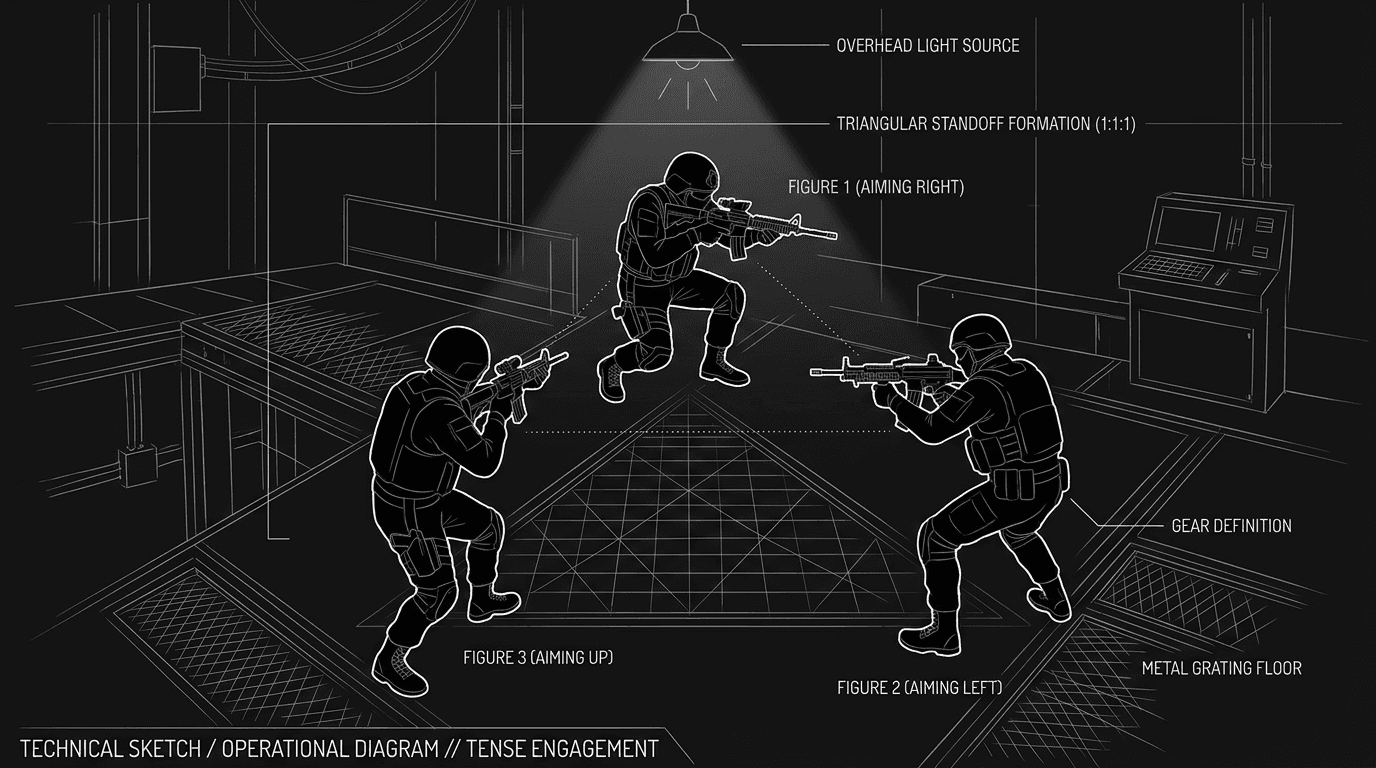
The "Mexican Standoff": Building Tension
Everybody has a gun on somebody.
Nobody can move without dying.
On the page, a Mexican standoff looks almost laughably simple: three (or more) characters, each threatening someone else, locked in place. In a bad draft, it’s a shouting match with pistols. In a great script, it’s one of the purest machines for tension you can build.
The difference isn’t the guns.
It’s how you use pressure, information, and options.
The worst standoffs feel like cosplay, characters barking clichés in a triangle while the story waits for the writer to decide who gets shot. The best ones feel inevitable and awful: whoever walks out has paid some non-refundable cost in blood, loyalty, or self-respect.
If you’re thinking of the diner in Reservoir Dogs, the final act of The Good, the Bad and the Ugly, or the cramped hallway confrontations in modern thrillers and prestige TV, you’re in the right neighborhood. But those scenes aren’t templates; they’re finished products of an underlying design.
Your job, as a writer, is to understand the design.
What a Mexican Standoff Actually Is (On the Page)
Let’s strip the trope down to its working parts.
Forget YouTube compilations of guys in trench coats shouting each other’s names. Think in terms of story physics.
A Mexican standoff is a configuration where:
- Every participant has immediate power over at least one other participant’s life or outcome.
- No one can exercise that power without exposing themselves to equal or greater risk.
- Time and outside forces are either closing in or threatening to break the balance.
Remove any one of those and you don’t have a standoff. You have an argument with props.
That first point matters more than people think. The guns don’t have to be literal. They can be:
A memory that will destroy a career.
Evidence that can put someone away forever.
A detonator. A livestream. A witness. A signed contract sitting on the table.
What makes the Mexican standoff recognizably itself is mutual vulnerability in a closed loop. A points at B, B points at C, C points at A. If any one of them takes a shot, literal or metaphorical, someone else’s “gun” fires too.
The Mexican standoff is less about who shoots first and more about who can live longest in the knowledge that shooting at all might be worse.
That’s why these scenes are often saved for late in the story. By the time you get there, you’ve had an entire film’s worth of promises, betrayals, and shifting alliances. The standoff is where all those IOUs come due in one compressed, ugly tableau.
Scenario 1: The Flat Triangle
Let’s take you into a problem draft.
Rafi is writing a crime feature. He knows he wants a Mexican standoff at the end: cop, criminal, and traitorous partner in an abandoned warehouse. He sets it up like he’s supposed to.
INT. WAREHOUSE – NIGHT
Weapons raised. Three people in a triangle. Rafi writes:
COP: “Drop the gun, Marcus.”
MARCUS: “You first.”
ALLY: “Everybody calm down. We’re all walking out of here.”
COP: “You lied to me.”
ALLY: “I had no choice.”
MARCUS: “You always have a choice.”
Guns stay up. They talk in circles. Someone does a countdown. At “three,” shots ring out. Two people drop. One survives.
On paper, Rafi has the ingredients. On the read, the scene is dead.
What went wrong?
First failure: no asymmetry of desire. All three characters want the same thing, “to walk out alive”, so their tactics blur. Nobody is willing to pay a different kind of price. They’re just waiting for fate.
Second failure: no pressure from outside the triangle. Nobody’s racing a clock. No sirens, no remote detonator, no livestream viewers, no incoming crew. The only pressure is the generic “we can’t stand like this forever,” which is abstract.
Third failure: no information edge. Everyone knows what everyone knows. There are no secrets to reveal, no mistaken beliefs to exploit. All that’s left is attitude.
You feel that on the page: a lot of posturing, no real movement.
The fix isn’t “add more shouting.” It’s redesigning the configuration so that every line costs someone something.
Asymmetry Is the Engine
In a memorable Mexican standoff, nobody is playing the same game.
One character wants survival at any cost. Another wants justice, even if it kills them. Another wants to burn down the whole system, if they die, that’s fine, as long as they take someone important with them.
Put those three in a room with guns and you’ll never have a static scene.
Think of it this way: if all three characters secretly agree that “the least bad outcome is all of us walking away,” your scene has nowhere to go. The moment someone finds a credible way to engineer that, the tension collapses.
But if:
One character would rather die than go to prison.
One character would rather kill than lose a sibling.
One character would rather expose everyone than keep the secret another day.
Then no “solution” satisfies everyone at once. Every path out is bloody.
That’s where asymmetry shows its teeth.
If you’ve done solid character work elsewhere, digging into want vs need, wounds, and moral lines like you might in a deeper craft piece on The Anti-Hero: Why We Root for Bad People, then the standoff becomes the place where those internal engines clash in one visible knot.
On the page, you encode this not in speeches about “what I want” but in choices:
The character who drops their gun rather than watch their partner get shot reveals their priorities.
The character who shoots a kneecap instead of a head shows a different calculus.
The one who refuses to disarm even when offered a safe exit exposes an agenda beyond survival.
Before you write dialogue, write those choices as a list. Then make sure the scene actually forces them to appear.
Scenario 2: The Rooftop With Nowhere to Go
Let’s build a workable standoff.
Rooftop. Night. Rain the budget can probably afford. Three players:
LENA – whistleblower, unarmed, holding a phone with damning evidence livestreaming.
KOVAC – corrupt cop, gun on Lena, wants the stream killed and the evidence wiped.
MILES – Lena’s partner, gun on Kovac, wants Lena alive and the story out.
You can already see the triangle:
Kovac can kill Lena.
Miles can kill Kovac.
Lena can destroy both careers by letting the stream run and naming names.
Now, asymmetry:
Lena would rather die than let Kovac bury the story.
Miles would rather live with a covered-up story than see Lena die.
Kovac would rather go to prison than let the department burn; he has family in the force.
No shared “ideal” outcome. Perfect.
Next: add external pressure.
Patrol units are two minutes out; Kovac’s bogus “officer needs assistance” call has backfired. The stream has a visible viewer count ticking up. There’s only so much battery left on Lena’s phone. The rooftop door is locked from the stairwell side; backup won’t arrive silently.
Now your standoff has:
Mutual threat.
Asymmetric desires.
Time pressure.
When you write this scene, you’re not just transcribing threats. You’re sculpting shifts in leverage as each of those elements changes.
Lena angles her phone so the audience can see Kovac’s badge number. That move shifts power away from Kovac toward the anonymous viewers.
Miles, distracted, lets his gun drift as he argues with Lena, giving Kovac a narrow exploit. That flicker of sloppiness is a beat of opportunity.
Sirens get louder. Suddenly, Kovac needs Miles alive as a witness to his version of events.
The dialogue lives on top of those shifts. Without them, it’s just noise.
The Geometry of Threat: Who Covers Whom?
On a physical level, a Mexican standoff is geometry.
Who is facing whom. Who can see which exit. Who is framed against the ledge, the door, the window. These choices do more than make a cool shot list, they dictate what’s possible in the scene.
You should treat that like blocking a fight.
On the page, that means being much more precise than “they all point guns at each other.”
If Kovac is between Lena and the ledge, he can threaten to push her off even if he loses the gun. If Miles is near the door, he hears the stairwell first. If Lena is kneeling, her options for sudden movement shrink.
This is where a quick comparison table can help check whether you’ve actually thought the physical power through:
| Character | Has Weapon? | Controls: Person | Controls: Exit | Visibility Edge |
|---|---|---|---|---|
| Lena | No (phone) | Stream narrative | None | Audience POV |
| Kovac | Gun | Lena’s life | Stairwell door | Nearest to exit |
| Miles | Gun | Kovac’s life | None | Sees ledge drop |
Look at that table and you immediately see one issue: Miles doesn’t control any exit or narrative. His only leverage is lethal. That tells you something about the kinds of lines and choices he’ll have. He’s the blunt instrument in a room where the other two can shape the story that survives.
If you can’t diagram who controls what in your standoff, you’re probably relying on “cool factor” instead of actual tension.
You don’t show the audience the table, obviously. But you feel its presence when you decide who steps where and why.
Visualizing the Triangle
Trench Warfare: What Beginners Get Wrong
Let’s get into the mud. Because once you start looking for Mexican standoffs in amateur scripts, you see the same failure patterns over and over.
Mistake 1: Confusing Loudness with Tension
Three people screaming isn’t tense. It’s exhausting.
Beginners max out the volume from line one. Everyone is already at eleven: veins popping, all-caps dialogue, endless swearing. There’s nowhere to go.
Real tension isn’t about decibels. It’s about choices being delayed and distorted by fear, pride, and limited information.
The more your characters yell, the more they flatten into emotional noise. The reader tunes out. The actors will, too.
The fix is brutal but simple: give yourself one truly loud outburst in the entire scene and make everything else live in the gradations below it.
Let the early lines be quiet, hissed, or measured. Let the volume spike only when leverage actually changes. Tie shouting to events, not to the writer’s need to signal “this is intense.”
Mistake 2: No One Ever Changes Their Aim
You’ve seen this: page after page of three guns pointed at three chests, unmoving. Then someone’s phone rings, everybody jumps, and the scene resets to the same poses.
If the aim never shifts, the relationships never shift.
In a living standoff, aim is a language.
When Kovac swings his gun from Lena to Miles, he’s saying: “You matter more in this instant. You are the leverage.” When Miles angles his gun down to a leg, he’s saying: “I’m not a murderer, but I will maim you.”
Every re-aim is an editorial.
On the page, you should track that:
Miles’ hands shake; the barrel dips an inch toward the rooftop gravel.
Lena’s phone hand drifts toward the ledge, forcing Kovac to step closer.
Kovac, realizing the sirens are nearly here, shifts his attention to the stairwell door for a fatal second.
If the only time weapons or leverage move is in the final beat, you’ve squandered the entire middle.
Mistake 3: Treating the Scene as a Plot Intersection, Not a Pressure Cooker
Many writers put too much burden on the standoff as a place to resolve everything at once: reveal who the traitor was, explain the backstory, confess love, kill a villain, set up a sequel.
The result is a clump.
Characters deliver exposition in between threats. Someone forgets they’re holding a gun long enough to do a two-page monologue about childhood. The actual tension stalls while the writer checks off plot boxes.
The standoff should be the place where previous work pays off, not where you try to squeeze in work you skipped.
If you find yourself thinking, “I’ll just have them explain it all when everyone’s in the same room,” stop. Go back. Earn those beats earlier. Let the standoff be about decision, not explanation.
This is the same craft mistake you see with overstuffed monologues and courtroom speeches, something you may have already explored if you’ve written big speeches or “all is lost” moments like in your guide to All Is Lost Moments Without Melodrama.
Mistake 4: No Moral Cost
The cleanest way to ruin a standoff is to make the “right” choice painless.
If the hero can resolve the scene by shooting the obvious villain with zero collateral damage, you didn’t need a Mexican standoff. You needed a firing squad.
What makes the trope stick is moral squeeze.
Maybe the only way to stop Kovac is to shoot him in the back as he turns toward Lena, betraying Miles’ own moral code about “never shoot a man who isn’t looking at you.” Maybe Lena has to end the stream to keep Miles alive, sacrificing the public truth she has fought for all story long. Maybe the only bullet that flies hits a bystander or ally.
The choice that ends the standoff should leave a scar.
Not just a narrative scar (we killed the villain) but a psychological one: guilt, compromised ideals, a relationship that can never quite be repaired. If everyone walks away morally intact, your scene was decorative.
Mistake 5: Ignoring Cultural Weight
You’re not writing in a vacuum. The phrase “Mexican standoff” carries a lot of cinematic baggage and more than a little cultural stereotyping from decades of Westerns and action movies.
If you drop the term into your script without thinking, you risk signaling “I’m mimicking a trope I’ve seen, not thinking about the people in my scene.” That can knock a reader out of the story in one shot.
You have options:
Use the trope without naming it. Just stage the geometry and let the audience clock the pattern.
Subvert it: maybe your characters explicitly call out the cliché (“What is this, some kind of cheap Mexican standoff?”) and then the scene spirals into something else.
Or, if you keep the term, be aware of its history and avoid leaning into ethnic caricature or lazy visual shorthand.
Treat the setup like you would any loaded device, like writing non-human characters or toxic relationships. The form is powerful, which means you have a responsibility not to sleepwalk through its implications.
Mistake 6: No Exit Strategy
Beginners often write themselves into a corner.
Three guns up. Everyone shouting. No one can logically lower their weapon without dying. The writer doesn’t know how to end it, so they pick someone at random to get shot by a stray bullet.
It feels like a coin flip because, on a craft level, it is.
The solution is front-loaded: design the exit before you write page one of the scene.
Ask:
Who must walk out of this room for the story to continue honestly?
What price do they need to pay to walk out?
What will be different about them, beliefs, relationships, self-perception, because of this scene?
Once you know that, you can plant the fuse. The moment that ends the standoff shouldn’t feel random; it should feel like the last domino in a line you carefully set earlier.
Try it free
Try Screenweaver for free on your script
It is free. Import your existing project, get a clearer view of your outline, and regain control of your story structure in minutes.
Start FreeContextual Image: The Pressure Diagram
A Step-by-Step Workflow for Designing Your Own
Let’s build a standoff from scratch using a concrete workflow you can reuse.
We’ll keep it intimate: three characters in a cramped motel room at the edge of town, late in Act Three of a low-budget thriller.
Characters:
NORA – ex-accountant who stole money from a cartel for a good reason, pistol in hand.
ESTEBAN – mid-level cartel fixer, unarmed but with men downstairs.
JAY – Nora’s younger brother, tied to a chair, bruised.
You want a “Mexican standoff” energy without just copying a triangle of guns.
Step 1: Write each character’s non-negotiable.
Nora will not go back to being powerless and obedient. Prison is preferable to returning to her old life.
Esteban will not walk away without securing the money; his own life isn’t worth much if he fails.
Jay will not let Nora trade her life for his; he’d rather die than watch her surrender completely.
Already you can see: “everyone lives” is off the table.
Step 2: Decide what “weapon” each really holds.
Nora’s pistol: literal power over bodies in the room.
Esteban’s phone: the ability to call in men who will kill everyone.
Jay’s secret: he knows where Nora hid the last ledger file that incriminates both sides.
No literal triangle of guns. But a triangular standoff of stakes.
Step 3: Map the initial geometry.
Nora between Esteban and the door, gun on him.
Jay tied to the chair by the window, too far for Nora to shield.
Esteban near the bathroom, phone in pocket, hands visible.
She can shoot him before he reaches the phone. He can yell for help before she can untie Jay. Jay can shout the ledger’s location into Esteban’s face and destroy Nora’s leverage.
That’s your loop.
Step 4: Sketch the pressure curve.
Start: verbal negotiation; everyone lies about what they’re willing to do.
Middle: one new piece of information shifts power (Jay knows something Nora didn’t, or vice versa).
Late: an outside force crashes into the room (cartel backup, police, fire alarm), forcing a decision.
Think of it as a smaller version of designing an “all is lost” beat or a midpoint shift, you’re reshaping who holds power and why.
Step 5: Pre-write three irreversible moves.
Nora shoots Esteban in the leg, not the chest: a choice that signals reluctance to kill.
Jay blurts out the ledger’s true hiding place, nuking Nora’s bargaining chip.
Esteban dials his men on speaker, puts the phone on the bed, and says, “If I don’t call back in thirty seconds, you know what to do.”
Notice how each of those moves changes the configuration.
After Nora shoots his leg, Esteban has a different moral high ground. After Jay blurts the secret, Nora’s leverage shifts from financial to purely physical. After Esteban makes the call, time pressure becomes the loudest character in the room.
Only after all of that do you write actual dialogue.
A YouTube Breakdown That Would Actually Help
[YOUTUBE VIDEO: Timed, side-by-side breakdown of three iconic “Mexican standoff” scenes, from a classic Western, a crime thriller, and a modern TV series, annotating onscreen which character holds leverage at each beat, when the aim or “weapon” shifts, and how external pressure (time, backup, environment) changes the outcome.]
Tiny Choices That Do the Heavy Lifting
Once the structure is solid, the tension lives in details.
Who uses whose first name. Who uses titles or slurs. Who laughs. Who never laughs. Who says “we” versus “you people.” Who corrects someone’s version of the past on a tiny detail that doesn’t matter… except it absolutely does.
Those micro-choices turn a mechanical standoff into a human one.
Esteban might call Nora “Señorita Accountant” instead of her name, a minor cruelty that tells you how he sees her. Nora might over-enunciate his name in return, refusing to use the soothing nickname everyone else does. Jay might crack a joke at the absolute worst possible time because his coping mechanism is to puncture tension, not respect it.
These behaviors don’t replace structure; they ride it.
They also connect back to the rest of your work on character dynamics. If you’ve been establishing the siblings’ rhythm all story, putting them under this kind of pressure should feel like a warped, condensed version of their usual pattern, not an entirely new show.
Ending Without Cheating
You’ve done the hard part. You’ve built the configuration, raised the pressure, avoided the cliché of three guys screaming in a circle.
Now you have to land it.
The temptation is to outsource the ending to chance: a loose floorboard, a misfire, a convenient sniper on the next rooftop. Anything that gets you out of the corner without forcing a character to stain their hands.
Resist that.
The end of a Mexican standoff should reveal who each person really is when stripped of alibis.
Maybe Nora chooses to shoot Esteban in the head when she could have taken his leg again, because she finally believes he’ll never stop. That says something brutal about how far she’s come from scared accountant to someone capable of decisive violence.
Maybe Jay, realizing Nora can’t pull the trigger, deliberately provokes Esteban into shooting him, detonating the ledger’s insurance clause that leaks everything to the press. His body is the cost of Nora’s survival and the story’s justice.
Maybe Esteban, unexpectedly, turns the gun on himself once he understands the cartel will torture his family for his failure, using his own death to buy them a fraction of safety. Not a redemption, exactly, but a last, sideways move in a life of bad choices.
Whatever you choose, the final beat shouldn’t feel like the writer rolling dice. It should feel like the outcome of who these people have always been, compressed into one frame.
And then you let the silence sit for half a page.
No quips. No immediate cut to sirens. Just bodies, breath, the sound of a phone call still connected or a stream still live. Let the reader feel the air finally move in a room that’s been locked for too long.
That’s where the real tension pays off, not in who falls, but in who’s left standing and what they’ve just proven themselves willing to do.
Final Step
Build your next script with Screenweaver
Move from ideas to production-ready pages faster with timeline-native writing and AI-assisted story flow.
Try Screenweaver