
Hero image prompt: Dark mode technical sketch. Solid black background, thin white hand-drawn lines. A single location, hotel corridor, lighthouse, house, drawn as if it has a pulse: slight distortion, repeated elements that don’t quite match. No people. The space feels like it’s watching. Minimalist, high-contrast.
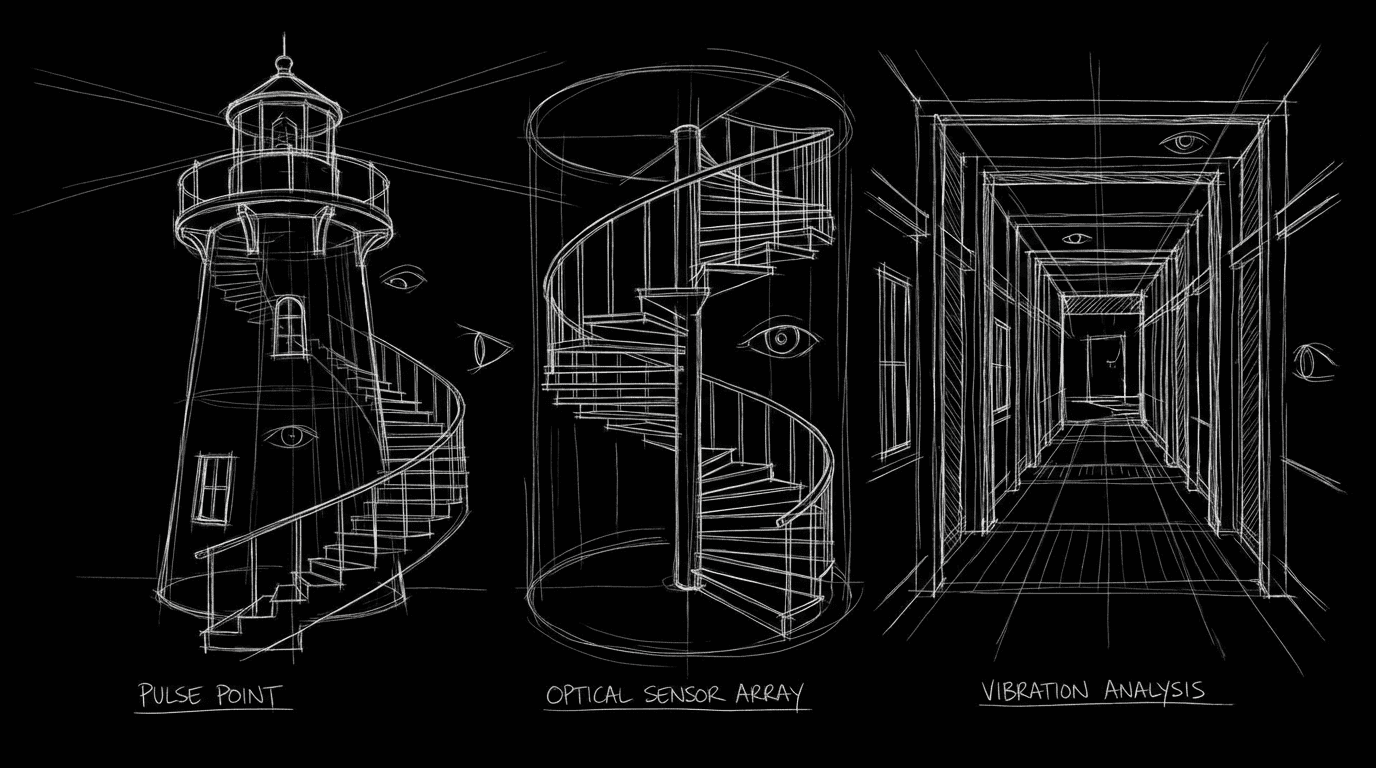
The Overlook has a layout that doesn’t make sense. The lighthouse has a sound that gets inside you. The house in Hereditary has corners that don’t add up. These places aren’t backdrop. They’re part of the story. When the setting is isolated, one hotel, one island, one house, it has room to become something more. A presence. A trap. A character. From The Shining to The Lighthouse, the best horror and drama use the location to do more than hold the action. They let the location push back.
The best isolated settings don’t just limit escape. They have rules. They have a mood. They change over the course of the story. That’s what makes them feel like a character.
Think about it this way. In a standard script, the character enters a room, something happens, they leave. The room is a container. In The Shining, the hotel is never just a container. It’s wrong. The layout is wrong. The history is wrong. The way it reflects the people inside is wrong. By the time we get to the climax, we’re not just afraid of what’s in the hotel. We’re afraid of the hotel. That shift, from “something bad happens here” to “this place is bad”, is what separates a location from an environment that acts like a character.
Why Isolation Forces the Setting to Work
When characters can leave, the setting is optional. They can go somewhere else. When they can’t, storm, distance, obligation, or something that won’t let them go, the setting becomes the world. Every scene happens there. The audience learns the corridors, the sounds, the way the light falls. That familiarity is what you’re building on. When the same corridor feels different the third time we see it, the change matters. When the sound we’ve been hearing since act one suddenly has a source, we feel it. Isolation gives the location screen time. Your job is to use that time to give it intention.
Isolation also raises the stakes. There’s no easy exit. No “we’ll come back with help.” The characters are stuck with the place and with each other. So the setting isn’t just where the story happens. It’s part of the pressure. The house that gets colder. The hotel that keeps shifting. The island that gets smaller as the tide comes in. The environment doesn’t have to be supernatural to feel active. It just has to change in ways that affect the characters and the plot.
Giving the Location Rules and Memory
Rules. Every strong location has rules. The Overlook has a history of violence and a winter that traps people. The lighthouse has a rhythm of shifts and a sound that drives people mad. The rules don’t have to be spelled out in dialogue. They can show up in behavior. Characters avoid certain rooms. They don’t go out at night. They follow routines that the place has imposed. When you break the rules, when someone goes where they shouldn’t, or does what the place “doesn’t allow”, that’s when the story can escalate. The location becomes a force that responds. For more on how to make the audience feel that pressure without spelling it out, see our guide on slow burn pacing.
Memory. The best isolated settings have a past. Something happened here. The characters might not know the full story. The audience might get it in pieces. But the place carries the weight of what happened. That history can explain why the place feels wrong. It can also give you payoffs. The room that “no one uses.” The name that keeps coming up. The object that shouldn’t be there. When the past of the place intersects with the present of the story, the location stops being a set and starts being a participant. Our piece on family secrets and the slow reveal applies: the location can hold secrets that the story uncovers.
Change over time. A character has an arc. So should the location. It doesn’t have to become literally evil. It can decay. It can get darker. It can feel smaller. The way you describe it in act one should be different from the way you describe it in act three. Maybe the corridors feel longer. Maybe the windows stop showing the outside. Maybe the sound that was background is now everywhere. The audience should feel that the place has shifted. That’s how the environment earns its role as a character, by having a trajectory.
| Element | What It Does | Example |
|---|---|---|
| Rules | Gives the place logic; breaking them creates consequence | Don’t go in the west wing; don’t go out after dark |
| Memory | Gives the place weight; past events explain present wrongness | The previous caretaker; the accident; the family that died here |
| Change over time | Gives the place an arc; same location, different feeling by act three | The hotel that feels bigger; the house that gets colder |
Relatable Scenario: The Cabin That’s Just a Cabin
You’re writing a horror script. The characters go to a cabin. Bad things happen. But when you read it back, the cabin could be any cabin. Swap it for a condo and the script would work the same. So you go back and give the cabin something specific. A layout that’s confusing, they keep passing the same room. A history, someone died here last year, or the family that built it went missing. A rule, the generator only runs at night, so they’re in the dark during the day. Now the cabin isn’t interchangeable. The story is happening because of this place. The isolation isn’t just “they’re far from town.” It’s “this place has them.”
Try it free
Try Screenweaver for free on your script
It is free. Import your existing project, get a clearer view of your outline, and regain control of your story structure in minutes.
Start FreeRelatable Scenario: The Lighthouse That Doesn’t Push Back
You’ve got two people in a lighthouse. They go mad. But the lighthouse itself is just a tall building. The audience doesn’t feel it. So you add the elements that The Lighthouse (2019) uses: the sound of the horn that never stops, the narrow space that forces them together, the rhythm of shifts that structures their days. The lighthouse isn’t passive. It’s loud. It’s cramped. It has a schedule. The characters are reacting to the place. Now the location is doing work. When one of them breaks the rhythm or challenges the space, the story has somewhere to go.
The Trench Warfare Section: What Beginners Get Wrong
Describing the place once and never again. You open with a long paragraph about the house. Then we’re inside and the house never changes. The audience forgets the description. Fix: return to the setting. Describe it again when something has changed, the light, the sound, the way a character moves through it. Let the same space feel different as the story progresses. The false ending and double climax often rely on the audience knowing the space well enough that when something is wrong, the door that was locked is open, we feel it.
Making the location generic. A “remote house.” A “dark forest.” When the setting could be anywhere, it doesn’t stick. Fix: give it specifics. The house with the red door and the well in the backyard. The forest where the trees grow in a circle. One or two concrete details make the place memorable. The rest of the atmosphere can build from there.
Forgetting that characters interact with the place. If the characters never touch the environment, never open the wrong door, never notice the sound, never break the rule, the location stays in the background. Fix: tie character choices to the place. They go where they shouldn’t. They use the thing that’s forbidden. They notice what’s wrong. The location and the characters have to affect each other.
Over-explaining the history. A character who delivers a five-minute monologue about what happened in the house is dumping exposition. The place’s past should come out in pieces, through action and discovery. Fix: show the history. The locked room. The photo. The date on the wall. Let the audience (and the characters) put it together. The location’s memory should feel earned, not announced.
[YOUTUBE VIDEO: Comparison of two or three iconic isolated settings, Overlook, lighthouse, Hereditary house, with commentary on how each uses rules, memory, and change to make the environment feel like a character.]
Step-by-Step: Building Your Location Bible
Before you write, give the location a short “bible.” One page. Where is it? What are the rules, stated or implied? What happened here before? What’s the mood in act one, and how does it shift by act three? List three to five specific details, sounds, objects, rooms, that will recur. When you write, refer back. Every time you return to the location, use at least one of those details or show a change. By the end of the script, the audience should know the place. They should feel like they’ve been there. That’s when the environment has become a character. For structure that supports this kind of escalation, the Fichtean curve for thrillers fits stories where the environment itself creates repeated crises.
One External Resource
For a concise overview of how setting functions in narrative, see the Setting (narrative) entry on Wikipedia. Reference only; not affiliated.
The Perspective
The isolated setting isn’t a convenience. It’s a choice. When you trap your characters in one place, you’re giving that place the chance to matter. Use it. Give it rules, memory, and change. Let it push back. By the time the audience leaves the theater, or turns the last page, they should feel like they’ve been somewhere. Not just anywhere. There.
Final Step
Build your next script with Screenweaver
Move from ideas to production-ready pages faster with timeline-native writing and AI-assisted story flow.
Try Screenweaver