
heist-movie-structure-assembling-crew
The Heist Movie Structure: Why “Assembling the Crew” Is Your Real First Act
The vault is not the point.
That’s the first thing most beginner heist scripts get wrong. They pour hours into inventing laser grids, biometric locks, impossible elevator shafts, and forget the simple truth every rewatchable heist film understands: the real spectacle is putting the wrong people in the same room and asking them to trust each other.
The audience wants to be there when the crew decides, against their better judgment, to do this together.
Think about your favorites. Ocean’s Eleven. Heat. Inside Man. Logan Lucky. You remember the twist or the final reveal, sure, but what you quote and gif and carry around is earlier: Danny and Rusty recruiting Basher. Jimmy and Clyde convincing Joe Bang to blow a vault from inside prison. Neil and his crew debating whether to walk away after a botched job.
Those scenes aren’t filler. They’re the load‑bearing structure.
If you treat “assembling the crew” like a quick montage of cool introductions before “the real movie” starts, your script will feel like a commercial for itself. If you treat it as Act One and most of Act Two, where power, loyalty, and motive are set in motion, the third act heist basically writes itself.
Let’s build that, piece by piece.
What the Audience Secretly Expects From a Heist Crew
Whether they articulate it or not, viewers walk into a heist story expecting three things:
1. Everyone brings a specific, indispensable skill.
2. Those skills clash at the worst possible moments.
3. Someone is not what they seem.
Everything you do in the assembly phase is either paying into or cashing out one of those expectations.
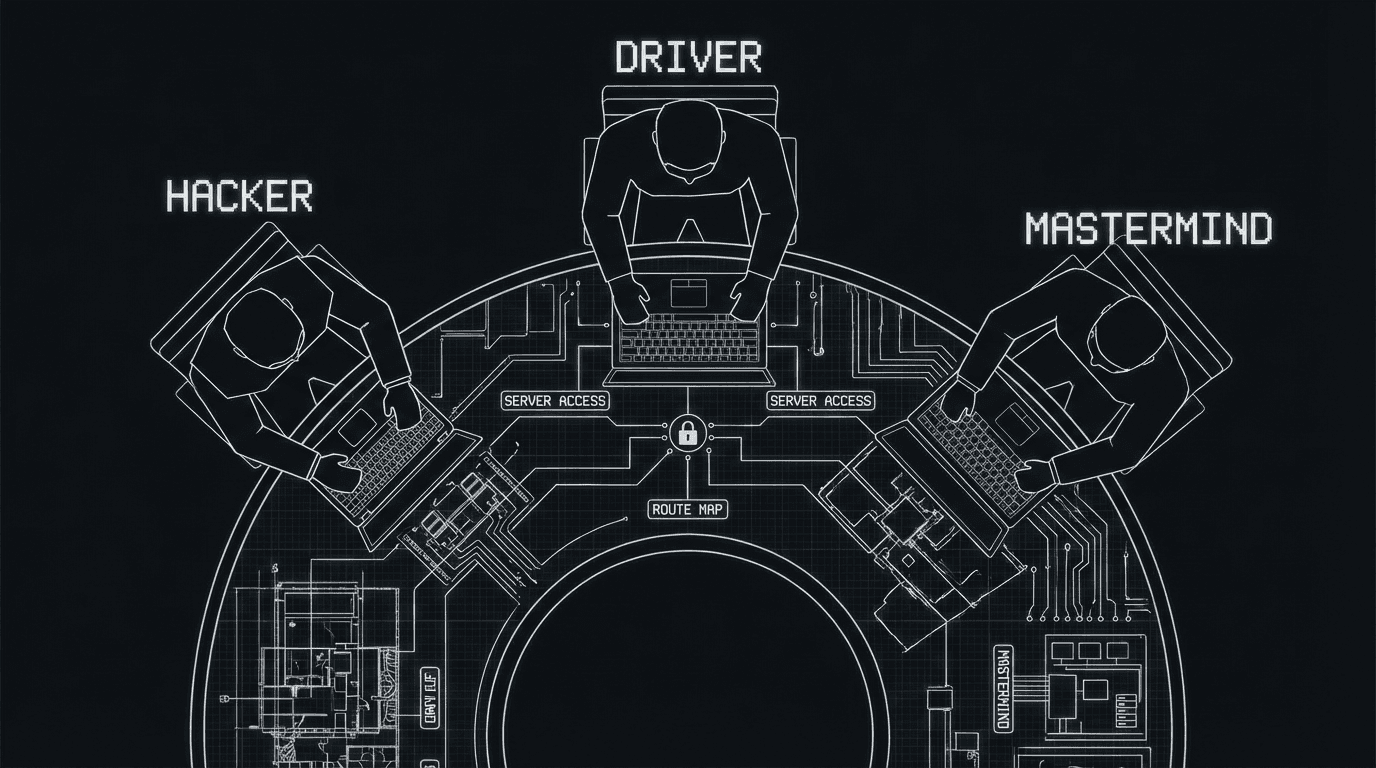
If your hacker is generic (“good with computers”), your driver is generic (“fast car”) and your muscle is generic (“big and angry”), you’re leaving money on the table. The script becomes a checklist: “we got a hacker, check, we got a driver, check,” instead of a series of seductions, negotiations, and future betrayals.
So before you write a single recruitment scene, decide:
- What very specific problem does each crew member solve that no one else can?
- What moral line is each one already willing to cross?
- Who has history with whom before page 1?
The heist structure isn’t just “get the people, plan the job, do the job.” It’s “build a temporary, unstable society under pressure and then watch it shake.”
Scenario 1: The “Casting Call” Assembly That Feels Like a Trailer
Let’s walk through a common beginner outline.
You’ve got your mastermind, Lex. You know you need:
- A hacker.
- A driver.
- A safecracker.
- Some muscle.
You sketch four short scenes:
Lex finds the hacker in a basement full of monitors. Offers a job. The hacker shrugs and says, “I’m listening.”
Lex watches the driver doing donuts in an empty parking lot. Offers a job. The driver grins and says, “I’m in.”
Lex meets the safecracker in a smoky bar. Offers a job. The safecracker stares at the blueprints and says, “This is insane. I love it.”
Lex picks up the muscle at an underground fight. Offers a job. The muscle nods.
Shot well, cut to a pulsing track, that makes a decent teaser. As a script, it’s dead.
Why? Because nothing is at stake in those scenes. Everyone was always going to say yes. You’ve already promised the audience “the crew” on the poster.
The fix is not complicated, but it demands that you write like each recruitment could fail.
Turn Every Recruitment Into a Moral Proposition
Start with a question:
“What is this character’s life costing them before Lex walks in?”
Your hacker might be bored doing corporate security work, but that’s not enough. What are they protecting by staying legit? A kid in private school? A sick parent with health insurance? A fragile new identity after a prison term?
Lex isn’t just selling a payout. He’s selling a risk that puts that delicate balance at stake.
Imagine the scene again with that in mind.
INT. BANK SERVER ROOM – NIGHT
Rows of humming machines. Soft corporate lighting.
JEN, 30s, in a blazer instead of a hoodie, is finishing a maintenance script.
Lex appears in the reflection of the server glass.
LEX:
You fixed the hole I left for you.
JEN doesn’t turn.
JEN:
I fixed a vulnerability in our system.
LEX:
You fixed fun.
He slides a folder between her and the keyboard. Blueprints. Camera grids. A photo of the bank’s smirking regional manager.
LEX (CONT’D):
He still tells people you’re “our diversity hire.” We both know that isn’t true.
He points to a junction on the blueprint.
LEX (CONT’D):
Three minutes here. One script. You walk out richer than this job will make you in five years.
JEN finally looks at him, then at her security badge.
JEN:
If I get caught, my kid loses this school.
LEX:
If you don’t, he learns his mother lets men like that keep what they stole.
Same “role” as before: hacker. Very different scene. The recruitment is a fight between fear and pride, not a handshake over a cool laptop.
You’re not just filling out a team. You’re rewriting each character’s self‑story in real time.
Structure: Where “Assembling the Crew” Lives in the Heist Spine
Classic heist structure looks something like this, no matter the setting:
- Act I – The offer and the need: why the heist must happen, why this mastermind is doing it now.
- Act II A – Assembling the crew + designing the plan.
- Act II B – Complications: rehearsals, test runs, leaks, and fractures.
- Act III – The heist and its consequences.
Notice that “assembling the crew” isn’t a cold open. It’s half the movie.
Within that, there’s a rhythm:
- Recruit a specialist.
- Reveal a piece of the plan that justifies that specialist.
- Show how adding them changes the social chemistry.
- Repeat, with escalation.
You can visualize it as two intertwined tracks:
- Operational track: what new capability the crew gains.
- Relational track: what new fault line they introduce.
For every addition to the team, ask:
- What can we do now that we couldn’t do before?
- Who does this threaten? Who does this empower?
- Who suddenly has something to prove?
If you can’t answer both sets, you’re adding decorative characters, not structural ones.
The Trench Warfare: Common Heist Assembly Mistakes
Let’s get into the specific ways heist scripts go sideways during crew assembly, and what to do instead.
Mistake 1: Everyone Respects the Mastermind Equally
If every recruit treats your mastermind like a legend, the dynamic goes flat. There’s no friction, no doubt, no one holding a mirror up to their flaws.
In good heist films:
- Someone owes the mastermind a debt.
- Someone resents them for a past betrayal.
- Someone has never heard of them and doesn’t care.
- Someone idolizes them a little too much.
Use recruitment scenes to lay this out, not to repeat “you’re the best in the game” four times.
Mistake 2: No One Has a Reason to Say No
“I’m in” is only satisfying if it costs something.
If every crew member is eager from the first pitch, you’ve told the audience that crime in this world is painless and consequence‑free. There’s no tension left in the decision.
Force at least one crew member to:
- Turn the mastermind down on first ask.
- Demand a cut or a condition that makes everyone else uncomfortable.
- Only agree because of a non‑financial lever (revenge, love, boredom, blackmail).
That way, you’ve planted a seed: this person is not aligned with the job for the same reasons as everyone else. That will bloom under pressure.
Mistake 3: Roles Are Redundant
A lot of specs have both “hacker” and “tech,” both “muscle” and “driver,” both “inside man” and “grifter,” doing essentially the same job.
It feels like richness; it’s actually mud.
Each role should pass the indispensability test:
“If I cut this person from the plan, does the entire design have to change?”
If the answer is “we’d just give their tasks to someone else,” either combine characters or sharpen their function.
Mistake 4: No Clear Moral Spread
Some of the best tension in a heist crew comes from moral diversity.
Imagine a slider:
Lawful / principled , , , , , , , , , chaotic / ruthless.
If everyone is hanging out on one side, the story will have to import morality from the outside (cops, civilians) and your crew will feel like a monolith.
Instead, deliberately place each member somewhere different on that slider:
- A professional thief with a strict code (“no civilians”).
- A traumatized veteran who treats this as war.
- A broke single parent who hates this but needs the money.
- A thrill‑seeker who wants a story to dine out on.
Then, in assembly scenes, let those positions clash in miniature so they can explode during the job.
Mistake 5: Assembly Is 100% Exposition
If every “we need you” scene turns into a lore dump about the security system, the plan, and people’s backstories, you will lose readers fast.
Use a simple discipline:
In each recruitment, reveal one crucial thing about the plan and one crucial thing about the recruit.
Everything else you can drip out later.
Try it free
Try Screenweaver for free on your script
It is free. Import your existing project, get a clearer view of your outline, and regain control of your story structure in minutes.
Start FreeDesigning a Crew as a Social Machine
Here’s a way to architect your crew before you write them into scenes.
Give yourself a small table like this in your notebook:
| Role | Public function | Private wound / motive | Attitude to mastermind |
|---|---|---|---|
| Mastermind | Design and lead the job | Needs to prove they’re not done | N/A |
| Hacker | Breach systems | Humiliated in current day job | Resents being under-used |
| Driver | Get in / out clean | Terrified of going back to jail | Loyal from past rescue |
| Inside man | Access to target space | Sick of being invisible | Underestimates mastermind |
| Wildcard | Flexible utility | Wants chaos more than money | Idolizes mastermind |
Now you’re not just juggling “cool” personalities. You’re building a tension grid.
Ask:
- Who will side with whom when trust breaks?
- Who is the easiest to flip by an outside offer?
- Who will blow everything up if they feel disrespected?
Once you’ve answered that, go back to your assembly scenes and let tiny versions of those fractures show themselves early: a joke that lands badly, a look across a table, someone clocking that two others already have a secret.
That’s structure. You’re baking in the third act collapses during the first act introductions.
A Concrete Workflow for Your Heist Assembly
Here’s a step‑by‑step process you can actually run when outlining.
Step 1: Write the Heist Logline and the Emotional Logline
Heist logline (external):
“When a broke paramedic mastermind learns that a corrupt hospital is laundering money through its billing system, she assembles a crew to rob its underground vault during a city‑wide blackout.”
Emotional logline (internal):
“It’s about whether she can stop seeing people, including her brother and her patients, as problems to fix and start trusting them as equals.”
Every crew member you recruit should press on that emotional line somehow.
Step 2: Decide Who Knows What, When
Use assembly to set up asymmetries of information.
- Maybe only the hacker knows the real depth of the corruption.
- Maybe only the inside man knows there’s a second vault.
- Maybe only the mastermind knows this is a revenge job, not just a score.
Sketch a simple grid: characters on one axis, secrets on the other. Fill in who knows what by which page. Recruitment scenes are the moments where that grid starts to fill.
Step 3: Link Each Recruitment to a Future Heist Beat
For each crew member, write:
“Because of how we recruited them, the moment they will break / shine in the heist is ______.”
Examples:
- We recruited the driver by preying on his fear of prison → during the heist, when a guard is injured, he has to choose between fleeing and turning back, knowing it could send him back inside.
- We recruited the hacker by insulting her corporate boss → during the heist, that boss shows up unexpectedly and she has to keep her cool or blow the operation.
- We recruited the muscle by saving his little brother → during the heist, the brother is used as leverage.
If you can’t connect assembly to execution like that, you’re leaving catharsis on the table.
Step 4: Make the Last Recruit Change the Rules
The final person you bring into the crew shouldn’t just be “one more specialist.” They should change the nature of the job.
That could mean:
- They insist on a non‑negotiable ethical line (“no guns,” “no civilians,” “we donate half”).
- They bring a political dimension (exposing corruption, not just stealing).
- They have a connection to someone on the other side (guard, manager, cop).
From that point on, the plan has to bend around them. The audience feels the stakes rise, not because the vault got bigger, but because the social machine got more volatile.
Where a Heist Article Like This Fits in Your Toolkit
If you’re building out a craft library for yourself, crew assembly overlaps with a lot of other skills.
It’s ensemble writing: you can cross‑reference ideas from any guide on juggling multi‑protagonist storylines (like our piece on ensemble casts and balancing arcs). It’s also close to bottle‑episode craft: large parts of many heists happen in one location with a fixed set of characters under time pressure, just like the one‑room TV episodes we talk about in our high‑stakes bottle episode guide.
The difference with heists is the promise of competence. The crew has to be good at what they do or the fantasy collapses.
That’s why the assembly phase is so critical. It’s where you convince us that:
- These people are the best (or at least the worst best) at what they do.
- Putting them together is a good idea in theory and a terrible idea in practice.
Once we believe those two things, you can take us anywhere: the vault, the double‑cross, the escape, the twist reveal that someone was playing a longer game.
We’ll buy it, because you sold us the crew.
The Perspective: Stop Treating Act One Like a Casting Reel
If you’re bored writing your own recruitment scenes, the audience will be bored watching them.
Stop thinking of “assembling the crew” as the obligation you have to clear before the fun starts. It is the fun. It’s where the story declares what kind of criminal universe this is, how loyalty works here, what money means to these people, and what will hurt when it’s taken away.
The vault will open or it won’t. The twist will land or it won’t. What lingers is whether, when someone says “I’m in,” we felt the risk, not just of prison or death, but of becoming the person this job requires.
Write that risk into every handshake, every blueprinted table, every quiet “you owe me.”
Then, by the time you hit “INT. CASINO – HEIST NIGHT,” your structure will already be doing what the genre promised all along:
Showing us not just how to steal something, but what it costs to turn a group of strangers into a crew.
Final Step
Build your next script with Screenweaver
Move from ideas to production-ready pages faster with timeline-native writing and AI-assisted story flow.
Try Screenweaver