
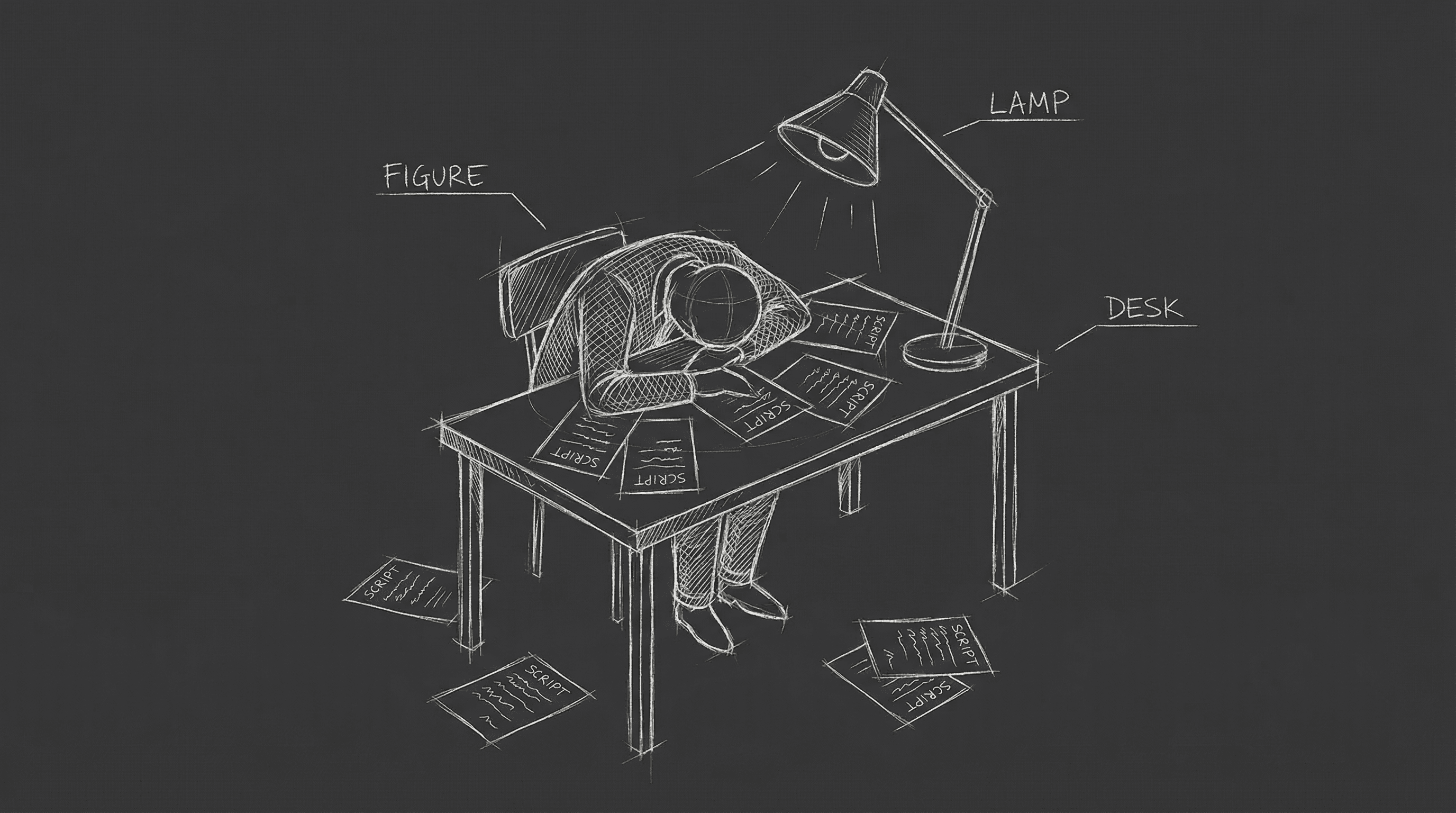
You've been grinding on the same draft for months. Or you've written three scripts in a year and submitted everywhere and the rejections are piling up. Or you're in a room and the pace is relentless. One day you sit down to write and nothing comes. Not block, emptiness. Or you're angry at the script. Or you're angry at yourself. Or you can't remember why you wanted to do this. That's not laziness. It's not a moral failure. It's burnout. And the fix isn't to push harder. It's to stop. Here's how to recognize it and what to do when you see the signs.
What Burnout Actually Is
Burnout is exhaustion that doesn't go away with a good night's sleep. It's emotional and mental depletion. You've been running at a high level for too long, creating, revising, submitting, absorbing feedback, starting again, without enough recovery. Your brain and body are saying: we need rest. Not "take the weekend off." Real rest. Days or weeks where the script is not the center of your life. Where you're not checking email for responses. Where you're not running the same scenes in your head. That can feel dangerous. Writers are told to show up every day. To never quit. But showing up when you're burned out doesn't produce good work. It produces more exhaustion and sometimes resentment toward the work itself. Rest is part of the job. Not a reward for finishing. A requirement for continuing. For more on sustainable pacing, see time management for part-time writers, the same principles apply: protect the block, but also protect the margin.
Rest is part of the job. Not a reward for finishing. A requirement for continuing.
Signs You Need a Break
You can't see the script clearly anymore. You've read it so many times that every scene looks the same. You don't know what's good or bad. You're making changes that don't improve anything, you're just moving furniture. That's a sign you've lost perspective. The only way to get it back is distance. Put the script away. Don't open it for a set period, a week, two weeks. When you come back, you'll read it with fresh eyes. You'll see what you couldn't see before.
You're resentful. The script feels like an obligation. You're angry at it, or at the process, or at yourself for "having to" do this. Resentment is a signal. Your system is overloaded. Pushing through will deepen the resentment. Step away. Let the script sit. Do something that isn't writing. When the resentment fades, you can return. If it doesn't fade, the break might need to be longer, or the project might need to be set down for good. That's not failure. That's honesty.
You're not producing, and you're punishing yourself. You sit down to write and nothing comes. You're not blocked in the creative sense, you're empty. Then you spend the rest of the day feeling guilty. "I should have written." "I'm wasting time." That cycle, empty, guilty, empty, is burnout. The fix isn't to force the words. It's to stop demanding them. Give yourself permission not to write. For a week. For two. The goal is to let the tank refill. Guilt keeps the tank empty. Permission lets it fill.
Your health is suffering. You're not sleeping. You're anxious. You're snapping at people. You're using the script as a way to avoid other problems, or you're so identified with the script that a rejection feels like a death. That's not just creative burnout. That's your whole system saying stop. Take a break. If it doesn't get better, talk to someone, a therapist, a doctor. Writing is not worth your health. Nothing is.
You've been at the same draft for a very long time with no progress. You're not stuck on a scene. You're stuck on the whole thing. You've rewritten the opening twenty times. You've gotten notes and done passes and the script isn't getting better, it's just different. Sometimes the right move is to put it in a drawer and write something else. Feedback fatigue is related: there's a point where more revision of this draft is not the answer. The answer might be a break. Or a new project. Or both.
| Sign | What it might mean | What to do |
|---|---|---|
| Can't see the script clearly | Lost perspective | Put it away for 1–2 weeks; no peeking |
| Resentment toward the script or process | Overload | Step away; no writing for a set period |
| Empty + guilty cycle | Burnout, not block | Permission not to write; rest |
| Health suffering (sleep, anxiety, mood) | System overload | Break + consider professional support |
| Same draft forever, no real progress | May need to stop or pivot | Consider putting it away; start something new |
Relatable Scenarios
Scenario one. You're on deadline. You don't feel like you can take a break. The room needs pages. The producer is waiting. But you're so tired that every scene you write is flat. You're not helping the project by grinding. You're hurting it. The professional move might be to communicate: "I need a few days to get my head right. I'll have the pages by X." Most people would rather get good pages later than bad pages on time. And if the deadline is truly non-negotiable, take the break immediately after. Don't roll straight into the next thing. You'll carry the depletion forward.
Scenario two. You're not on deadline. You're writing on spec. You've been at it for months. You're not having fun anymore. You're not sure the script is getting better. You're afraid that if you stop, you'll never come back. So you keep going. But coming back after a break is a skill. You're allowed to practice it. Take two weeks off. Don't open the script. Do other things. See how you feel. Often the fear that you'll never return is the burnout talking. After rest, the desire to write often returns. And if it doesn't, that's information. Maybe this project has run its course. Maybe you need a different project to fall back in love with the process. The loneliness of the long-distance screenwriter can make burnout worse, no one to tell you "take a break." So tell yourself. And if you have a community, tell them. They'll get it.
Scenario three. You've taken a break. You came back. You still feel empty. That might mean the break wasn't long enough. It might mean the issue isn't just fatigue, it's something else (depression, life stress, a project that's no longer right for you). Be honest. Extend the break. Or talk to someone. Or start a small, low-stakes project, a short, a different genre, to see if the spark is still there. Burnout doesn't always resolve in two weeks. Sometimes it takes longer. Give yourself that.
What Beginners Get Wrong: The Trench Warfare Section
Confusing burnout with block. Block is "I don't know what happens next." Burnout is "I don't have the energy to care." The fixes are different. For block, you try exercises to unstick the story. For burnout, you rest. Don't try to write through burnout. You'll dig the hole deeper.
Feeling guilty for resting. The culture says "writers write every day." So when you take a break, you feel like you're failing. You're not. You're maintaining the machine. Athletes rest. Musicians take time off. Writers are allowed to rest too. The goal is a long career. Not a short burst and a crash.
Using the break to "get ahead" on other work. A break means not writing. Not "I'll use this time to outline the next script" or "I'll catch up on reading." Those are still work. Rest means rest. Walk. Sleep. See people. Do something that isn't productive. The point is to let the creative system go offline. It comes back when it's ready.
Returning too soon. You took three days off. You're still tired. You force yourself back to the desk. You're not recovered. You're just back. Give yourself a real break. A week minimum. Two is better. When you come back, start small, one scene, one page. Don't try to make up for lost time. Ease in.
You're not helping the project by grinding. You're hurting it.
Try it free
Try Screenweaver for free on your script
It is free. Import your existing project, get a clearer view of your outline, and regain control of your story structure in minutes.
Start FreeHow to Take the Break
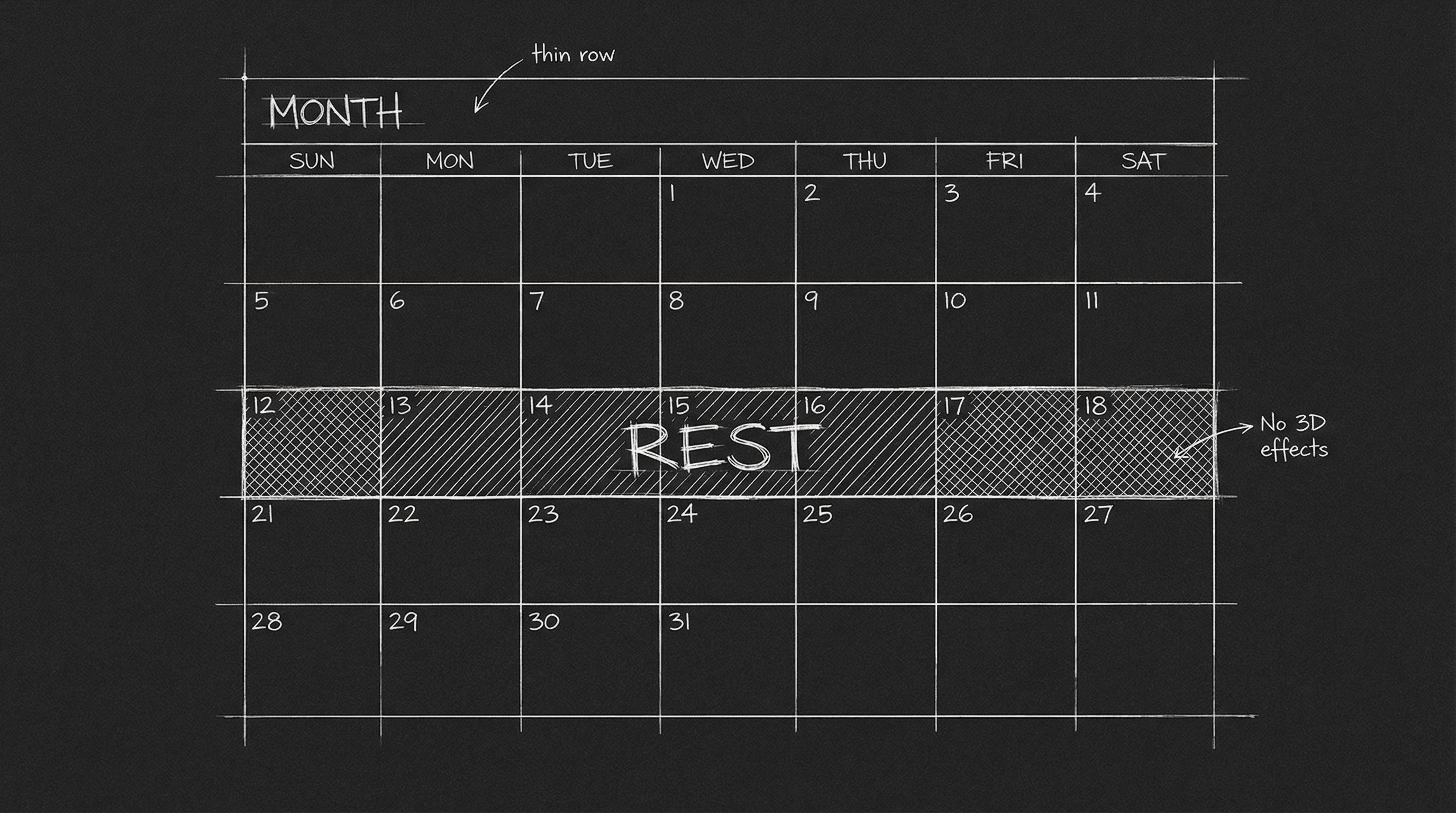
Set a end date. "I'm not writing for two weeks." That way you're not wondering every day "is it time yet?" You have permission until the date. Then you can reassess.
Put the script away. Don't leave it open on your desktop. Don't "just check" a scene. Put it in a folder. Close the tab. Out of sight. The goal is to stop the mental loop.
Do something that isn't writing. Not "I'll use the time to research." Not "I'll watch movies for craft." Something that has nothing to do with the script. Exercise. See friends. Cook. Sleep. Let the brain do something else.
Tell someone if it helps. "I'm taking two weeks off the script." Saying it out loud can make it real. And it can reduce the guilt. Someone else knows. They're not judging. They're just aware.
When you return, start small. Don't try to do a full day of writing on day one back. Do thirty minutes. Or one scene. Ease in. The goal is to re-establish the habit without re-triggering the burnout.
One External Anchor
Burnout is recognized by health organizations (e.g. WHO) as an occupational phenomenon, characterized by exhaustion, cynicism, and reduced efficacy. Knowing it's defined and studied can reduce the sense that you're "just weak." (<a href="https://www.who.int/news/item/28-05-2019-burn-out-an-occupational-phenomenon-international-classification-of-diseases" rel="nofollow">WHO on burnout</a>.)
[YOUTUBE VIDEO: A writer or showrunner talks honestly about a time they burned out, what the signs were, what they did, how long it took to come back.]
The Perspective
Burnout is not a character flaw. It's the result of sustained demand without enough recovery. The fix is to stop. Not to push harder. Not to feel guilty. To put the script away, rest, and let the system refill. When you come back, you'll see the work more clearly. You'll have energy again. And you'll be less likely to crash the next time, because you'll know that rest is part of the job. Take the break. The script will still be there. You'll be better when you return.
Final Step
Build your next script with Screenweaver
Move from ideas to production-ready pages faster with timeline-native writing and AI-assisted story flow.
Try Screenweaver