

The French script is sixty-three pages. It's a family drama set in Marseille, three generations of women fighting over the sale of a bakery. The dialogue is sharp. The silences say more than the words. In the original language, a single phrase, "C'est pas grave", recurs eight times across the story, each time with a different emotional weight: dismissive, bitter, resigned, finally hopeful. Direct translation? "It's not a big deal." Which is dead. Which says nothing. Which guts the entire emotional arc.
This is the translation problem: language carries culture, and culture carries meaning. You can transliterate every word correctly and still produce a script that doesn't work. The American reader doesn't hear what the French reader heard. The rhythms are wrong. The references don't land. The subtext evaporates.
For decades, script translation was a job for specialists, bilingual writers who understood both the source culture and the target audience. They weren't just translating; they were adapting. Finding American equivalents for idioms. Adjusting humor. Restructuring sentences so they landed in English the way they landed in the original. It was slow, expensive, and dependent on finding the right person.
Now there's a new tool in the kit. Language models can translate at speed. They can process a ninety-page script in minutes. They can even detect register, formal versus colloquial, and adjust accordingly. But they cannot, on their own, preserve subtext. They cannot feel when "C'est pas grave" should become "It's fine" versus "Don't worry about it" versus "Whatever" versus silence followed by a door closing.
The question isn't whether to use these tools. The question is how to use them without losing what made the original worth adapting in the first place.
Cinematic workflow frames
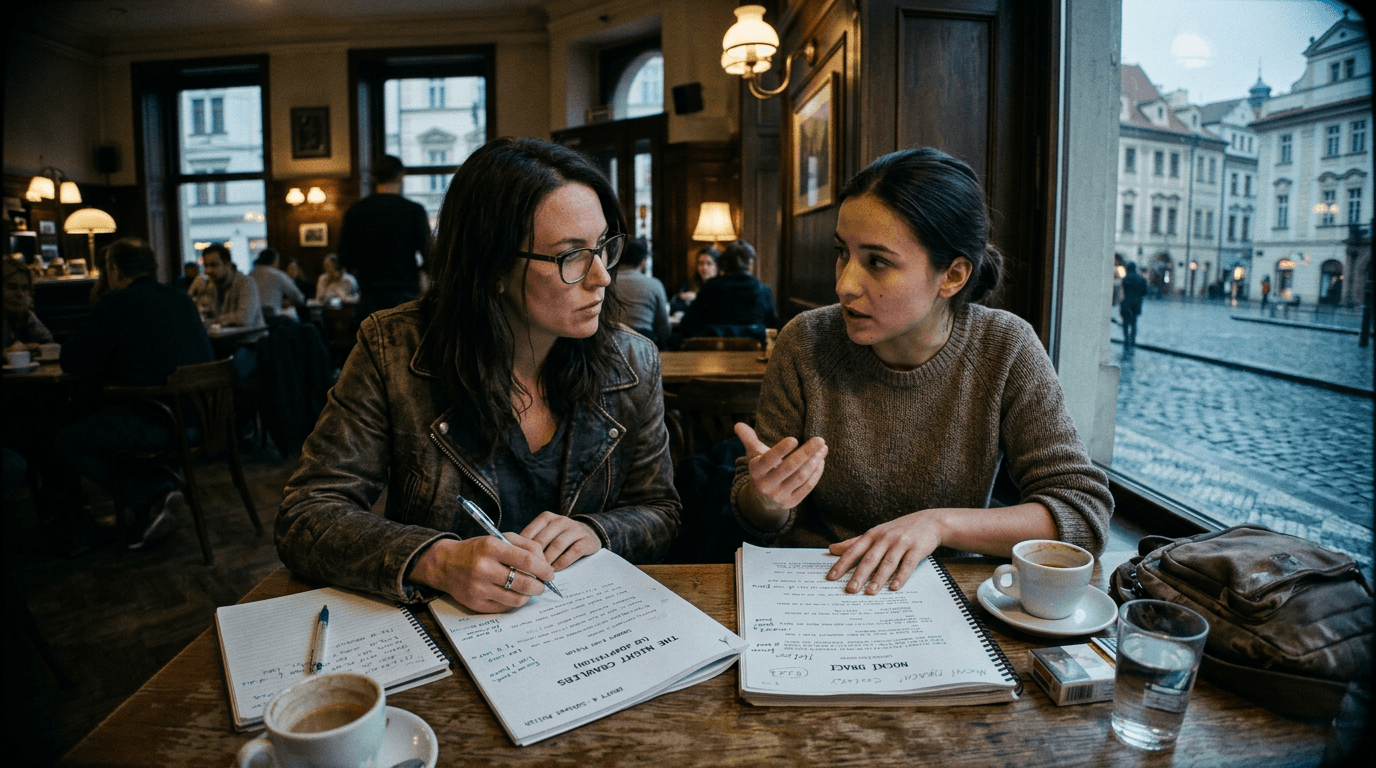
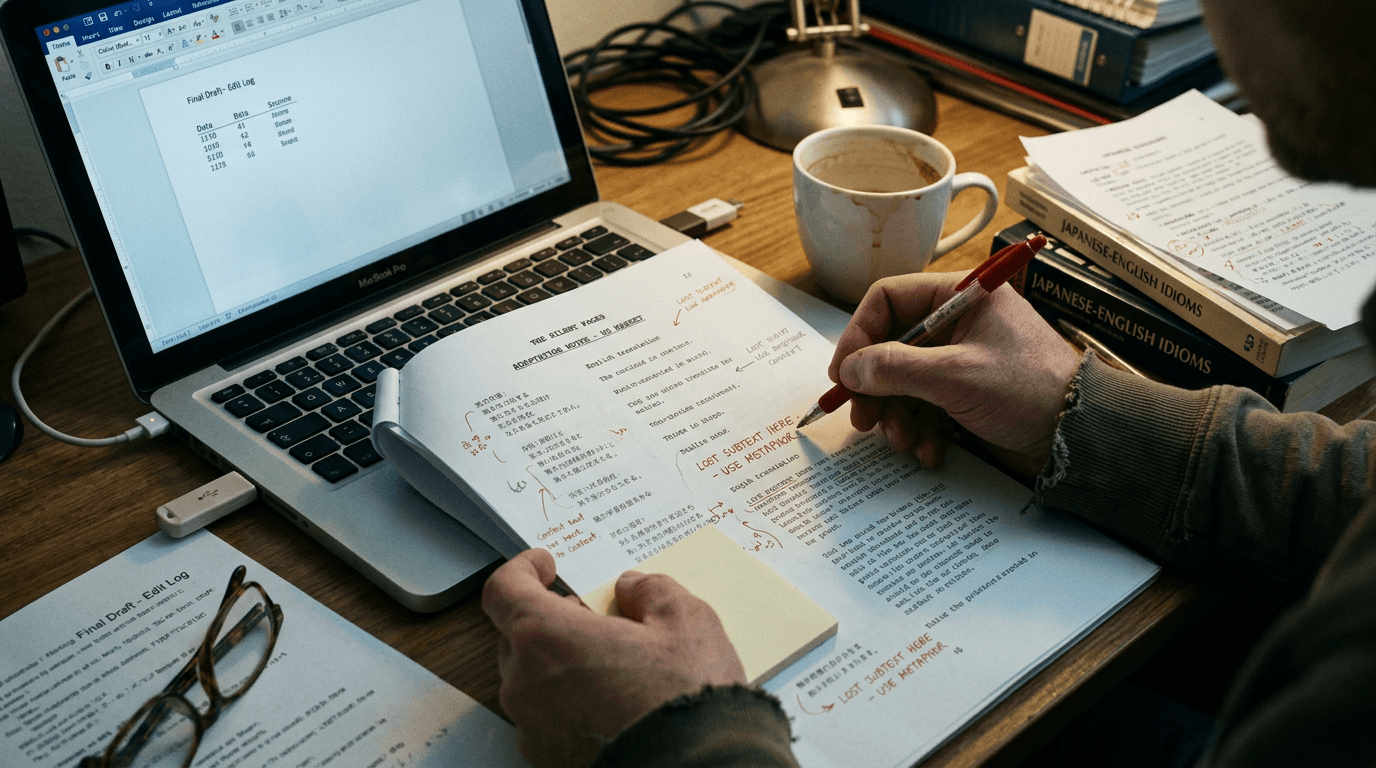
These two visuals work as a pair: the first shows Cinematic workflow still, first angle, 35mm film grain, and the second shifts to Cinematic workflow still, second angle, 35mm film grain—compare them briefly, then move on.
Why Script Translation Is Harder Than Document Translation
Translation software has gotten good. Really good. You can drop a business contract into a language model and get a usable English version in seconds. Technical manuals, medical literature, news articles, the tools handle these competently. But scripts are different. Scripts don't just convey information; they perform emotion through rhythm, subtext, and cultural assumption.
Consider this: in a business document, clarity is the goal. In a script, ambiguity is often the goal. A character says one thing and means another. The surface text is never the whole story. Translating the surface while losing the subtext produces dialogue that reads correctly and plays wrong.
There's also the question of oral performance. Scripts are meant to be spoken. The length of a sentence matters. The number of syllables matters. The hard and soft sounds matter. A line that works beautifully in German might produce an English equivalent that's too long, too clunky, or too soft to carry the same weight. This is why translation of poetry and drama has always been considered an art, not a procedure.
A good translation isn't a mirror. It's a reperformance in a different register.
When you adapt a script for the US market, you're not just translating language. You're translating assumptions about family, class, humor, shame, and ambition. You're translating what doesn't need to be explained (because everyone in the source culture already knows it) and what must be explained (because the target culture doesn't). This is cultural translation, and it requires human judgment.
What Language Models Actually Do Well
That said, let's not dismiss the tools. They have real strengths.
Raw speed. A ninety-page script translated by a human might take a week. A language model produces a first pass in minutes. That first pass might be rough, but it exists, and you can work from it.
Consistency of terminology. If a character always calls another character by a nickname, the model will usually catch this and replicate it throughout. Human translators sometimes drift.
Detection of register. Modern models can distinguish between formal and informal speech, between technical jargon and everyday language. If one character speaks like a lawyer and another speaks like a teenager, the model will often preserve that difference, imperfectly, but noticeably.
Handling of straightforward exposition. When characters are simply conveying plot information ("The train leaves at eight. We need to be there by seven."), the model translates cleanly. It's the loaded moments, the emotional and culturally specific, where it struggles.
Flagging uncertainties. If you prompt the model correctly, it can indicate where it's unsure: "The phrase 'Tu m'étonnes' is idiomatic. Possible English equivalents: 'No kidding,' 'Tell me about it,' 'You're not wrong.' Context may determine the best choice."
These strengths make language models useful as a first-pass tool, a way to accelerate the human translator's work, not replace it.
A Step-by-Step Workflow: From Source to Adapted Script
Let's walk through how this actually works when you're adapting a foreign script for the US market.
Phase One: Raw Machine Translation
You feed the script into a language model and get a literal translation. Don't expect polish. Expect accuracy at the word level and awkwardness at the sentence level. The model doesn't know your characters; it's translating text, not drama.
Export this as a working draft. You'll revise it heavily, but now you have something to revise.
Phase Two: Parallel Reading
Open the original script and the translated draft side by side. Read them in parallel, scene by scene. Mark any line where the English feels "off", too long, too blunt, missing a beat. Mark any line where you suspect the model missed subtext.
This is the diagnostic phase. You're not rewriting yet; you're identifying problems.
Phase Three: Subtext Recovery
For each marked line, return to the original and ask: What is this character actually saying beneath the words? What do they want? What are they hiding? Then find an English line that accomplishes the same emotional work.
This is the creative translation step. It may involve changing the literal meaning of a line to preserve its dramatic meaning. "Je suis fatiguée de tout ça" translates literally as "I'm tired of all this." But if the character is about to walk out on her marriage, maybe the English version is "I'm done." Shorter. Harder. More final. Same dramatic function.
Phase Four: Rhythm and Speakability Pass
Read the script aloud, or have actors read it. Where do lines stumble? Where do actors naturally want to add or drop words? A screenplay is an oral document. If a line doesn't flow when spoken, it needs adjustment.
Pay attention to sentence length. English often prefers shorter, punchier sentences than some European languages. French and German scripts sometimes have long, winding dialogue that works in the original rhythm but drags in English. Break sentences. Cut filler. Let the pauses breathe.
Phase Five: Cultural Localization
This is where adaptation diverges from translation. Some references won't land with American audiences. A French character who mentions "le bac" (the national exam) won't register the same class and educational stakes with an American viewer. Do you keep the reference and let it float, or do you substitute an American equivalent?
There's no single answer. Some films lean into foreignness as a feature; others naturalize aggressively for commercial appeal. But you need to make conscious choices about how foreign the final script should feel.
Phase Six: Polish and Readback
Final pass. Read the script as if you'd never seen the original. Does it hold up as an English-language drama? Does the dialogue feel natural? Does the plot track? This is the quality gate. If something doesn't work in this read, it doesn't work.

A Table of What Requires Human Intervention
Not every line needs heavy adaptation. Here's a rough guide:
| Line Type | Can Machine Translate? | Human Intervention Needed? |
|---|---|---|
| Plot exposition ("The meeting is at noon.") | Yes, reliably | Minimal, check for flow |
| Neutral dialogue ("Pass me the salt.") | Yes, reliably | Minimal |
| Idioms and slang | Partial, often literal | High, must find cultural equivalent |
| Subtext-heavy dialogue (what's meant ≠ what's said) | No | Essential, requires creative reinterpretation |
| Humor (puns, wordplay, cultural jokes) | Rarely | High, may need total rewrite |
| Formal register (legal, medical, military) | Yes, usually | Low, check jargon accuracy |
| Dialect or regional speech | Inconsistent | Moderate, decide on American equivalent |
| Silences and what's unspoken | N/A | Full human judgment |
The machine handles the simple stuff. The human handles everything that matters.
Try it free
Try Screenweaver for free on your script
It is free. Import your existing project, get a clearer view of your outline, and regain control of your story structure in minutes.
Start FreeThree Scenarios: Adapting Different Kinds of Scripts
Scenario A: A Korean Thriller
The script is a tense cat-and-mouse story between a detective and a serial killer. Most of the dialogue is functional: interrogations, phone calls, procedural exposition. But there are two key scenes, a confrontation between the detective and his dying father, and a monologue from the killer explaining his philosophy, where subtext and rhythm are everything.
Machine's role: Translate the procedural scenes cleanly. Flag the two key scenes for human attention.
Human's role: Rewrite the father-son scene with an ear for American father-son dynamics (which differ from Korean norms). Rework the killer's monologue so it lands philosophically without feeling like a dubbed anime villain.
Outcome: A script that moves fast through the plot scenes and hits hard in the emotional peaks. The machine saved days of work; the human saved the soul.
Scenario B: A Spanish-Language Family Comedy
The script is set in a multi-generational household in Mexico City. The comedy relies heavily on wordplay, generational slang, and cultural references (telenovelas, specific political figures, regional food jokes). Much of this has no direct English equivalent.
Machine's role: Produce a flat translation that preserves plot structure. Flag every pun and cultural reference.
Human's role: Invent American equivalents. A joke about a specific Mexican snack becomes a joke about a different American snack. A reference to a telenovela trope becomes a reference to an American soap opera trope. Some jokes will simply die; new jokes must be written.
Outcome: A script that functions as an American family comedy, possibly set in a Mexican-American household to preserve cultural flavor while making references legible to US audiences. The final product is more adaptation than translation.
Scenario C: A Danish Art Film
The script is slow, elliptical, and largely silent. Dialogue is sparse. Much of the meaning is conveyed through implication, visual cues, and the particular cadence of Danish understatement.
Machine's role: Translate the dialogue, which is minimal. Generate a first-pass action-line translation.
Human's role: Preserve the white space. Resist the urge to over-explain. American scripts often add exposition where European scripts leave gaps. The translator must protect the silences, which are doing dramatic work.
Outcome: A script that reads "slow" by American commercial standards, but that's the point. The translation should feel like the original, not like a Hollywood version of the original.
The "Trench Warfare" Section: What Beginners Destroy
If you're new to script translation, or if you're a producer asking someone inexperienced to adapt a foreign script, here's where things go wrong.
Failure Mode #1: Over-Literalism
The translator produces word-for-word equivalents without regard for dramatic function. "She took her leave of the gathering" instead of "She left." The meaning is technically correct; the line is dead on arrival.
How to Fix It: Always ask: How would an American screenwriter write this moment from scratch? Then find the overlap between that and the original's intent.
Failure Mode #2: Cultural Flattening
Every regional or cultural marker is stripped out. The script could be set anywhere. This happens when the translator (or producer) fears that foreign specificity will alienate American audiences.
How to Fix It: Specificity is compelling. The goal isn't to erase culture; it's to make culture legible. Keep what's interesting; clarify what's confusing.
Failure Mode #3: Subtext Becomes Text
The original character hints at something painful in her past. The translator, trying to help the American audience, makes her say it outright. Now the scene has no tension.
How to Fix It: Trust the audience. If the subtext is clear enough for a French audience to infer, it's clear enough for an American audience too. You can add a small contextual nudge; you shouldn't add a confession.
Failure Mode #4: Rhythmic Collapse
The original has a musical quality, short lines, long lines, silences, overlaps. The translation flattens everything into mid-length sentences of uniform structure. The music is gone.
How to Fix It: Vary sentence lengths deliberately. Read aloud. If the translation doesn't sound right, it won't play right.
Failure Mode #5: Trusting the Machine for Emotion
The producer runs the script through a language model and sends it to actors without human review. The actors struggle with lines that technically make sense but emotionally don't land.
How to Fix It: The machine is a starting point. Every scene with emotional stakes needs a human pass. There are no shortcuts for subtext.

Who Should Do This Work?
The ideal translator for US adaptation isn't just bilingual. They're bicultural. They've consumed American film and television deeply enough to know what "sounds right" in an American script. They understand American actors' instincts, the tendency to underplay, the preference for naturalistic delivery, the way American audiences parse hesitation differently from European audiences.
This person might be a native speaker of the source language who's lived in the US for years. It might be an American with deep immersion in the source culture. It might be a team: one for accuracy, one for Americanization.
What this person is not: a machine. And what the machine is not: a replacement.
The model accelerates the workflow. It catches low-stakes lines and frees the human to focus on the high-stakes ones. But if you hand a machine-translated script to a reader without human adaptation, they will feel it. They might not know why the dialogue feels off, but they'll feel it.
What Changes When You Succeed
A well-adapted script doesn't read like a translation. It reads like a script. The dialogue sounds like people talking. The cultural references are either translated or clarified. The rhythm is correct for English. The subtext is intact.
When you hand this script to an American actor, they don't have to "act around" awkward phrasings. The lines fit in the mouth. When you hand it to an American producer, they don't have to imagine what it would sound like "once we fix the translation." It's already fixed.
This is the goal: to create a document that functions in the American market the way the original functioned in its home market. Not a perfect replica, that's impossible, but a functional equivalent. A reperformance in a different register.
The Perspective: Translation Is Not Betrayal
There's a famous Italian saying: "Traduttore, traditore." Translator, traitor. The idea is that all translation involves loss, and all loss is a kind of betrayal.
Here's a different way to think about it. Translation is not betrayal. It's triage. You cannot bring everything across the bridge. Some nuances will be lost. Some rhythms will change. What you can do is choose which elements to protect and which to sacrifice. That's the art.
Language models make this triage faster. They give you a first draft instantly, so you can spend your time on the hard choices instead of the easy ones. But they don't make the hard choices for you. The decision of whether "C'est pas grave" becomes "It's fine" or "Don't worry about it" or a wordless shrug followed by a door closing, that decision is yours.
And if you make it well, the American audience will feel something real. Not a photocopy of the original feeling, but something adjacent, something true. That's as close to fidelity as translation ever gets.
[YOUTUBE VIDEO: A side-by-side comparison of a scene from a foreign-language film and its adapted English version, with a translator explaining the choices made and tradeoffs involved.]
Further reading:
- For strategies on writing your own subtext-heavy dialogue, see our guide on what characters hide.
- If you're formatting live translations or interpreter scenes, see our guide on formatting earpiece and translator dialogue.
- The American Translators Association has resources on literary and media translation standards at atanet.org{:rel="nofollow"}.
Final Step
Build your next script with Screenweaver
Move from ideas to production-ready pages faster with timeline-native writing and AI-assisted story flow.
Try Screenweaver