

Eight writers. Five acts. Forty-eight hours until the table read. Each writer took a section, standard practice for a room on a deadline, and now the pages are coming back. Someone needs to make them sound like one show.
This is the harmonization problem. Co-written sitcoms are patchwork by design. Writer A nails the B-plot but runs long on dialogue. Writer B writes tighter jokes but makes the protagonist sound meaner than intended. Writer C's rhythms are perfect for the mom character but slightly off for the dad. The showrunner reads everything and thinks: This reads like four different shows.
Harmonizing used to mean sitting in a room, reading pages aloud, and rewriting on the fly. That still happens. But now there's another tool in the kit: language analysis software that can flag inconsistencies before the human pass even begins. These tools don't write jokes. They don't make creative decisions. What they do is surface patterns, vocabulary frequencies, sentence lengths, speech cadence, that help humans see where the stitching shows.
This isn't about automating comedy. It's about using analysis to identify where the comedy sounds off, so humans can fix it faster.
Cinematic workflow frames
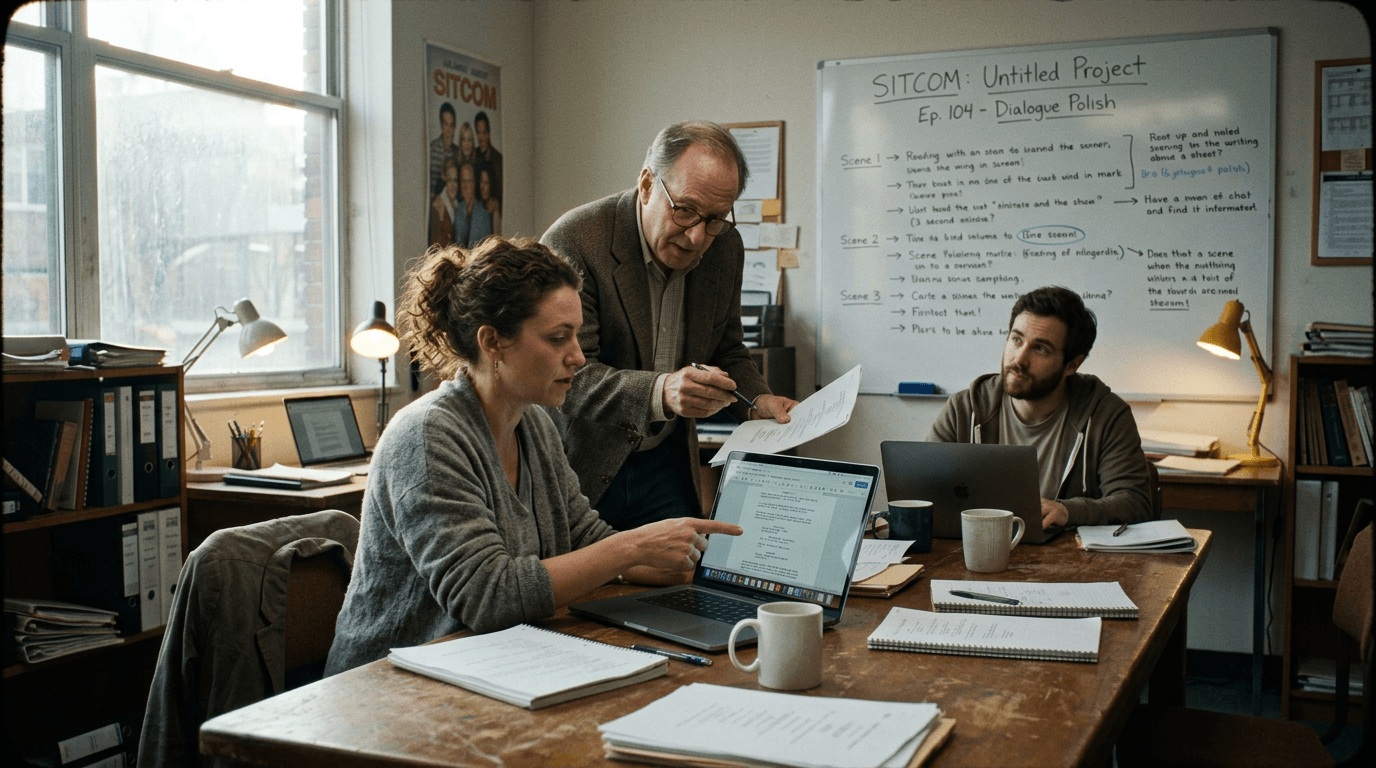
These two visuals work as a pair: the first shows Cinematic workflow still, first angle, 35mm film grain, and the second shifts to Cinematic workflow still, second angle, 35mm film grain—compare them briefly, then move on.

What "Harmonizing" Actually Means in a Writers Room
Let's define the problem precisely. Sitcom dialogue has to serve three masters simultaneously:
Character voice. Each character should sound distinct. The neurotic accountant doesn't talk like the laid-back bartender. If you muted the names and read the dialogue, you should be able to tell who's speaking based on vocabulary, sentence structure, and rhythm.
Tone consistency. A single-cam dark comedy feels different from a multi-cam broad comedy. The show establishes rules: how mean can the jokes get, how realistic is the dialogue, how much meta-humor is allowed. Individual writers can drift from these rules, especially under deadline pressure.
Scene rhythm. Sitcoms have a physical rhythm, setup, escalation, joke, button. That rhythm affects line lengths, pause placements, and how much the dialogue "breathes." When one writer's scenes feel faster or slower than the surrounding material, the episode feels lumpy.
Harmonization is the process of bringing all pages into alignment across these three dimensions. Traditionally, this is the showrunner's job (or the script coordinator's, or a designated "punch-up" writer's). They read everything, identify friction, and rewrite until the episode feels unified.
The challenge is that this process is slow and relies heavily on intuition. An experienced showrunner can feel when something's wrong. But explaining what is wrong, and catching it before the table read rather than during, is harder.
Where Language Analysis Tools Fit In
This is where language models and text analysis tools offer leverage. They can't tell you what's funny. But they can tell you things like:
Vocabulary divergence. Character X uses "awesome" in Writer A's scenes and "great" in Writer B's scenes. Is this intentional variation or inconsistency?
Average sentence length. Writer A's dialogue averages twelve words per line; Writer B's averages twenty. The scenes will feel paced differently, and actors may struggle with the tonal shift.
Contraction frequency. Formal characters avoid contractions ("I am not going to do that"); casual characters use them ("I'm not gonna do that"). If a casual character suddenly sounds formal in one section, the tool flags the drift.
Repeated jokes or constructs. Writer C uses "That's what she said" twice in Act Two. Writer D uses it once in Act Three. Nobody noticed, but now the running gag feels overused.
Character-specific word markers. If the show bible says the mom never swears but she drops "damn" in a scene, the tool can catch it.
None of this replaces reading the script. But it gives the harmonizing team a map of potential problems before they start. Instead of hunting for inconsistencies, they're confirming and fixing flagged issues.
A Realistic Workflow: Analysis Before the Human Pass
Let me walk through how this works in practice.
Step One: Draft Submission
Each writer submits their assigned scenes by 6 p.m. Friday. The script coordinator compiles them into a single document and uploads it to the analysis tool.
Step Two: Automated Scan
The tool runs overnight. By Saturday morning, there's a report. The report includes:
- A per-character vocabulary frequency breakdown (what words each character uses most often, per writer)
- A dialogue-length analysis (average words per speech, per writer)
- A flag list of potential inconsistencies (character voice drifts, repeated phrases, tone outliers)
- A read-time estimate per act (useful for pacing)
Step Three: Showrunner Review
The showrunner reviews the report over coffee. They don't read every item; they scan for patterns. Writer B's scenes flag for long speeches, check. Writer D's scenes flag for the mom using more casual language than usual, noted. A joke structure appears three times across two writers, worth consolidating.
Step Four: Targeted Rewrite
Instead of rereading the entire script looking for problems, the showrunner goes directly to flagged scenes. They compare the flagged dialogue against the show bible and previous episodes. Where the flag is a real problem, they rewrite. Where it's a false positive, they move on.
Step Five: Table Read
By Monday, the script is harmonized. The table read proceeds. There may still be issues, there always are, but the major voice inconsistencies are already resolved.
This workflow doesn't eliminate human judgment. It accelerates it. The tool doesn't decide what sounds right; the human does. But the human no longer has to hunt.

A Table: What the Tools Can and Cannot Do
| Task | Tool Capability | Human Still Required? |
|---|---|---|
| Flag vocabulary inconsistencies | Yes | Human decides if it matters |
| Measure average dialogue length | Yes | Human decides if the variance is intentional |
| Detect repeated joke structures | Partial, catches exact phrases, not conceptual echoes | Human must assess humor |
| Compare character voice across writers | Yes, statistical patterns | Human validates against show bible |
| Assess whether a joke is funny | No | Entirely human judgment |
| Suggest replacement dialogue | Weak, often off-brand | Human rewrites |
| Catch factual continuity errors | Limited | Human fact-checks |
| Identify pacing issues | Yes, via read-time estimates | Human adjusts |
The pattern is clear. Tools surface data; humans make decisions. The tool's value is in reduction of search time, not replacement of creative judgment.
Three Scenarios: Different Shows, Different Needs
Scenario A: Multi-Cam with a Veteran Staff
A legacy sitcom with eight writers, most of whom have been on the show for years. The characters' voices are deeply established. Most writers already sound alike because they've internalized the voice over time.
Tool's role: Minimal. Occasional flags for new writers or guest writers who haven't yet nailed the tone. Mostly useful for catching fatigue drift, when the room gets tired late in the season and the writing gets sloppy.
Human's role: Light polish. The experienced staff self-corrects. The showrunner reads for logic and pacing, not voice.
Scenario B: Single-Cam with a New Room
A new show with a mixed staff, half experienced, half early-career. The show's voice isn't fully established. Each writer brings their own rhythms, and it's not yet clear which rhythms belong to the show versus to the individual.
Tool's role: Heavy. The analysis tool helps the showrunner see patterns: Writer A writes short, punchy; Writer C writes long and conversational. Neither is wrong, but the show needs to choose. The tool surfaces the variance so the room can have an intentional conversation about tone.
Human's role: Active negotiation. The showrunner isn't just fixing inconsistencies; they're defining the show's voice by deciding which patterns to keep.
Scenario C: Late-Season Crunch
A show three seasons in, but the room is understaffed this year. Fewer writers, shorter turnarounds. Scripts go out with less polish because there isn't time for multiple passes.
Tool's role: Triage. The tool flags the worst inconsistencies so the showrunner knows where to spend limited rewrite time. A scene that's slightly off can slide; a scene where the protagonist sounds completely out of character cannot.
Human's role: Prioritization. The showrunner can't fix everything, so they fix what matters most. The tool helps them rank problems.
Try it free
Try Screenweaver for free on your script
It is free. Import your existing project, get a clearer view of your outline, and regain control of your story structure in minutes.
Start FreeThe "Trench Warfare" Section: What Goes Wrong
Failure Mode #1: Over-Trusting the Flags
The tool flags that Character B uses "basically" three times in Act Two. The showrunner removes all three instances. But two of those "basicallys" were intentional, Writer A was using the word as a tic that pays off later in the episode.
How to Fix It: Flags are not instructions. Every flag requires human validation. Ask: Is this inconsistency a problem or a choice?
Failure Mode #2: Homogenizing Voice
The tool shows that Writer C's dialogue is significantly different from the other writers. The showrunner rewrites all of C's scenes to match the average. But C's scenes were the funniest in the episode, the variance was a feature, not a bug.
How to Fix It: Variance isn't automatically bad. Some writers bring a spice that elevates the show. Harmonize for character consistency, not stylistic conformity. Don't erase what makes the writing sing.
Failure Mode #3: Ignoring the Tool Entirely
The showrunner trusts their gut. They don't run the analysis. They read the script, rewrite what feels off, and send it to the table read. At the read, actors stumble over dialogue in scenes the showrunner didn't flag, because the problems were subtle and the showrunner's gut wasn't calibrated for them.
How to Fix It: Use the tool as a second pair of eyes, not a replacement for your own. Even experienced showrunners have blind spots. The tool catches what intuition misses.
Failure Mode #4: Running the Tool on First Drafts
The writers submit rough drafts, ideas, not polish. The tool flags hundreds of inconsistencies. The report is overwhelming. Nobody reads it.
How to Fix It: Run the tool on second drafts, after individual writers have cleaned their own work. The tool is best at catching residual problems, not first-pass chaos.
Failure Mode #5: Forgetting Performance
The tool says the dialogue is consistent. The showrunner approves the script. At the table read, the actors point out that one scene is impossible to say aloud, the sentences are too long, the comedic timing is off, the breath marks are wrong.
How to Fix It: Text analysis can't hear performance. Always read dialogue aloud, or have actors read it, before locking. The tool catches statistical problems; actors catch performative problems.

Building Character Voice Profiles
One practice that accelerates harmonization: building a voice profile for each major character and using the analysis tool to enforce it.
A voice profile is a short document (half a page to one page) that captures the linguistic fingerprint of a character:
- Vocabulary markers: Words they use often. Words they never use.
- Sentence structure: Short and declarative? Long and winding? Questions or statements?
- Contraction usage: Do they say "I'm" or "I am"?
- Comfort with profanity: What's the strongest word they'd use?
- Reference world: What do they know about? Sports? Books? Pop culture? What's outside their reference range?
Once you have voice profiles, you can configure the analysis tool to flag deviations. If the mom character never uses contractions and a scene has her saying "I've gotta go," the flag appears.
This isn't micromanagement; it's codified knowledge. In a room with turnover, new writers joining mid-season, guest writers on specific episodes, the voice profile preserves consistency. Writers don't have to infer the rules; the rules are written down and computationally enforced.
Voice profiles turn intuition into infrastructure. When the showrunner leaves for a doctor's appointment, the profile keeps the character in line.
The Speed Argument: Why This Matters on a TV Schedule
Television production is relentlessly scheduled. A half-hour sitcom might have six to eight days from table read to shoot. A one-hour drama might have ten. There's no time for leisurely revision.
Every hour saved in harmonization is an hour the room can spend on actual comedy, punching up jokes, solving story problems, refining character arcs. If the analysis tool cuts four hours of inconsistency-hunting per episode, that's four hours redeployed to work that makes the show better.
This is the real value proposition. Not that the tool writes comedy, it doesn't. Not that it replaces writers, it can't. The value is time. And in television, time is the scarcest resource.
What This Looks Like at Scale
Over a season, twenty-two episodes, say, the cumulative time savings become significant. But there's also a secondary benefit: pattern tracking.
By running every episode through the same tool, you accumulate data about the show itself. You start to see:
- Which writers tend to run long on dialogue (helpful for assignment matching)
- Which characters have experienced voice drift over the season
- Which acts consistently run over or under time
- Where the room's comedic defaults are (repeated joke structures, overused setups)
This data becomes institutional knowledge. When you break a new season, you already know where the show tends to drift and where it holds steady. You can brief new writers with evidence, not just instinct.
The Perspective: Tools Don't Write Comedy, But They Keep Comedy Coherent
There's a fear in writers rooms that technology will replace writers. This fear is understandable but, in the context of harmonization tools, misplaced. These tools don't write jokes. They don't invent characters. They don't know what's funny.
What they do is hold up a mirror. They show the room where consistency breaks down, and they do it faster than any human could. The room still decides what to do with that information. The room still rewrites. The room still laughs or doesn't laugh at the table read.
Harmonization tools make collaboration smoother. They reduce the friction of patchwork scripts. They free showrunners from the drudgery of hunting for problems so they can focus on the craft of solving them.
In a well-run room, nobody talks about the harmonization tool. It just works, quietly surfacing issues that humans fix. The show sounds like one show, because the infrastructure caught the moments when it didn't.
That's not replacing comedy. That's enabling it.
[YOUTUBE VIDEO: A showrunner explaining how their writers room uses text analysis tools to harmonize dialogue across multiple writers, with examples of before-and-after dialogue comparisons.]
Further reading:
- For guidance on creating distinct character voices, see our guide on the blind-read test for ensemble dialogue.
- If you're building a series bible that includes voice profiles, our series bible generation guide covers the format.
- The Writers Guild offers resources on collaborative writing practices at wga.org{:rel="nofollow"}.
Final Step
Build your next script with Screenweaver
Move from ideas to production-ready pages faster with timeline-native writing and AI-assisted story flow.
Try Screenweaver